

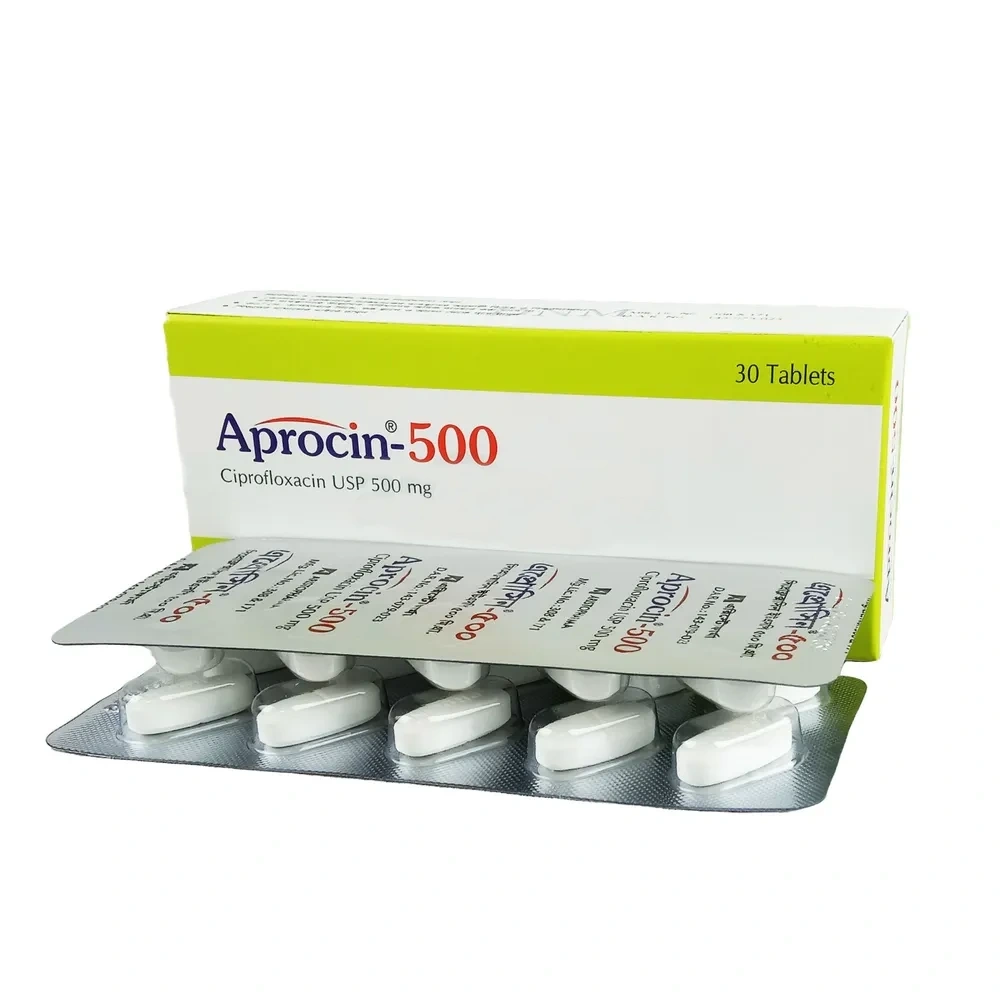

Medicine Overview of Aprocin 500mg Tablet
- Bacterial infections
- Nausea
- Diarrhea
Avoid Aprocin 500 with caffeine and chocolate as well as food containing caffeine and chocolate such as tea leaves, cocoa beans.
-
Your doctor has prescribed Aprocin 500 to cure your infection and improve symptoms.
-
Do not skip any doses and finish the full course of treatment even if you feel better.
-
Discontinue Aprocin 500 and inform your doctor immediately if you get a rash, itchy skin, swelling of face and mouth, or have difficulty in breathing.
-
Diarrhea may occur as a side effect but should stop when your course is complete. Inform your doctor if it doesn’t stop or if you find blood in your stools.
-
Notify your doctor if you feel pain in your tendons, numbness, or tingling sensations.
-
Inform your doctor if you are pregnant or planning to conceive or breastfeeding.
IV Administration
Infuse 1-2 mg/mL (diluted in D5W or NS) into large vein over 60 minutes
IV 20–30 mg/kg/day, max 1.2 g/day q12h.
Children and adolescents: RTI & GI infections: Neonate-15mg/kg twice daily, Child (1 month -18 years)-20mg/kg (max 750 mg) twice daily;
UTI: Neonate-10 mg/kg twice daily, Child (1 month -18 years)-10mg/kg (max 750 mg) twice daily;
Pseudomonal lower respiratory tract infection in cystic fibrosis: Child (1 month -18 years) – 20mg/kg (max 750 mg) twice daily; Anthrax (treatment & post exposure prophylaxis): Child (1 month -18 years) – 20mg/kg (max 750 mg) twice daily.
CrCl >50 mL/min: Dose adjustment not necessary
CrCl 30-50 mL/min: 250-500 mg PO q12hr
CrCl <30 mL/min: Extended-release, 500 mg PO q24hr
CrCl 5-29 mL/min: 250-500 mg PO q18hr or 200-400 mg IV q18-24hr
Some clinicians suggest decreasing dose but not frequency of administration
Hemodialysis: 0.25-0.5 g PO q12hr or 0.2-0.4 g IV q24hr
Peritoneal dialysis: 0.25-0.5 g PO q8hr or 0.2-0.4 g IV q24hr
Nausea (3%),Abdominal pain (2%),Diarrhea (2% adults; 5% children),Increased aminotransferase levels (2%),Vomiting (1% adults; 5% children),Headache (1%),Increased serum creatinine (1%),Rash (2%),Restlessness (1%)
<1%
Acidosis,Allergic reaction,Angina pectoris,Anorexia,Arthralgia,Ataxia,Back pain,Bad taste,Blurred vision,Breast pain,Bronchospasm,Diplopia,Dizziness,Drowsiness,Dysphagia,Dyspnea,Flushing,Foot pain,Hallucinations,Hiccups,Hypertension,Hypotension,Insomnia,Irritability,Joint stiffness,Lethargy,Migraine,Nephritis,Nightmares,Oral candidiasis,Palpitation,Photosensitivity,Polyuria,Syncope,Tachycardia,Tinnitus,Tremor,Urinary retention,Vaginitis
Potentially Fatal: Anaphylactoid reaction; cardiopulmonary arrest.
Lactation: Drug enters breast milk; use not recommended (American Academy of Pediatrics Committee states that drug is compatible with nursing)




Reviews
Clear filtersThere are no reviews yet.