


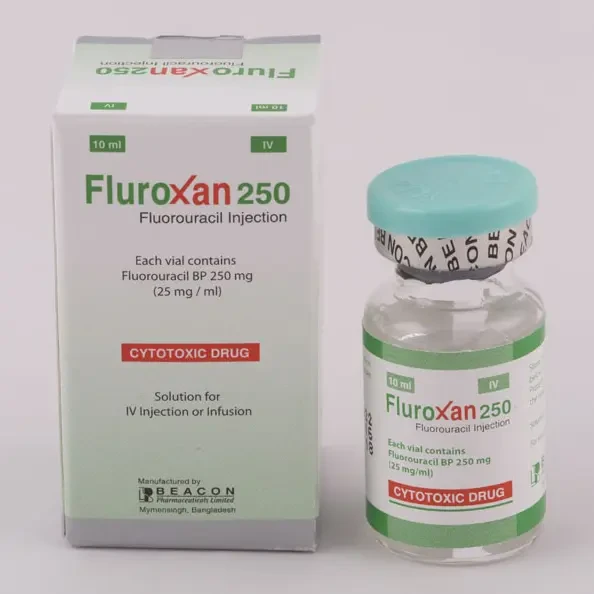

Medicine Overview of Fluroxan 250mg/10ml Injection
Fluroxan 250 is used in the treatment of cancers of stomach, colon, rectum, breast, and lungs. It may be used to treat other conditions, as determined by the doctor. It is sometimes used with certain other medicines as part of combination chemotherapy.
Fluroxan 250 is given as injection under the supervision of doctor. Your doctor will decide what dose is necessary and how often you need to take it. This will depend on what you are being treated for and may change from time to time. You should take it exactly as your doctor has advised. Taking it in the wrong way or taking too much can cause very serious side effects. It may take several weeks or months for you to see or feel the benefits but do not stop taking it unless your doctor tells you to.
The most common side effects of this medicine include increased risk of infection, mouth ulcer, vomiting, weakness, and nausea. This medicine may reduce the number of blood cells (decrease red blood and white blood cells) in your blood, thereby, increasing the susceptibility to infections. Regular blood tests are required to check your blood cells along with heart, liver, and blood uric acid levels.
Before taking it, tell your doctor if you have heart disease, liver, or kidney problems or are taking any medicines to treat infections. Many other medicines can affect, or be affected by, this medicine so let your doctor know all medications you are using. This medicine is not recommended during pregnancy or while breastfeeding. The use of effective contraception by both males and females during treatment is important to avoid pregnancy.
- Cancer
- Increased risk of infection
- Mouth ulcer
- Vomiting
- Weakness
- Nausea
- Loss of appetite
- Hair loss
- Blisters on fingers/feet
- Decreased blood cells (red cells, white cells, and platelets)
- Diarrhea
-
Fluroxan 250 helps treat cancers of stomach, colon, rectum, breast, and lungs.
-
It is given as an injection into a vein, or as a drip (infusion) into a vein or artery.
-
The dose and the number of treatment cycles needed will depend on the type and stage of cancer that is being treated.
-
It may cause dizziness and visual changes. Do not drive or do anything requiring concentration until you know how it affects you.
-
Your doctor may regularly monitor your blood cells and liver function during treatment with this medicine.
IV Preparation
IV Push: dose/syringe (concentration: 50 mg/mL); max syringe size for IVP is 30 mL syringe and syringe should be <75% full
Continuous IV Infusion/IVPB: dose/50-1000 mL D5W or NS; syringe and solution are stable for 72 hr at 4 to 25°C
IV Administration
Direct IV push injection (50 mg/mL solution needs no further dilution) or by IV infusion
Toxicity may be reduced by giving the drug as a constant infusion
Bolus doses may be administered by slow IVP or IVPB
Warm to body temperature before using
Continuous IV infusion may be administered in D5W or NS
Solution should be protected from direct sunlight
5-FU may also be administered intra-arterially or intra-hepatically
Use plastic IV containers for continuous infusions (stable in plastic IV bags than in glass bottles)
Adult: IV Palliation of malignant neoplasms 12 mg/kg/day (max: 0.8-1g/day) for 3-4 days, if no toxicity occurs, may be followed after 1 day w/ 6 mg/kg on alternate days for another 3-4 doses. May repeat course 4-6 wk later or maintenance doses of 5-15 mg/kg (max: 1 g) may be given wkly.
Cancers of Colon, Breast, Ovary, Liver, Pancreas, Rectum, Stomach
Various protocols exist
500 mg/sq.meter IV on Days 1-5, OR
450-600 mg/sq.meter IV weekly, OR
200-400 mg/sq.meter IV continuous infusion qD
Not to exceed 800 mg/day
As an infusion: 15 mg/kg/day (max: 1 g/day), continue until toxicity occurs or a total of 12-15 g is given. May repeat course 4-6 wk later. Intra-arterial Palliation of malignant neoplasms 5-7.5 mg/kg/day as continuous infusion (regional perfusion).
Hepatic impairment: Dose reduction may be required.
Child: Safety & efficacy not established.
Regular monitoring of blood counts. History of heart disease, hepatic or renal insufficiency, weak or malnourished patients, patients who with history of high-dose pelvic radiation or use of alkylating agents. Patients with widespread metastases to the bone marrow.
Lactation: excretion in milk unknown; do not nurse.
1-10%
Loss of appetite,Headache,Nausea,Vomiting,Diarrhea,Mucositis,Myelosuppression,Alopecia,Photosensitivity,Hand-foot syndrome,Maculopapular eruption (pruritic)
Frequency Not Defined
Angina,Coronary arteriosclerosis,Thrombophlebitis,Darkening of veins,Gastrointestinal ulcer,Increased alkaline phosphatase,Increased LFTs,Hyperbilirubinemia,Hypercholesterolemia (increased LDH),Anaphylaxis,Nystagmus,Ophthalmic findings
Potentially Fatal: Central neurotoxicity, myocardial ischaemia.
Pregnancy Category: D
Risk Summary
There are no adequate and well-controlled studies with fluorouracil in pregnant women. Based on its mechanism of action, fluorouracil can cause fetal harm when administered to a pregnant woman.
Lactation: excretion in milk unknown; do not nurse





Reviews
Clear filtersThere are no reviews yet.