



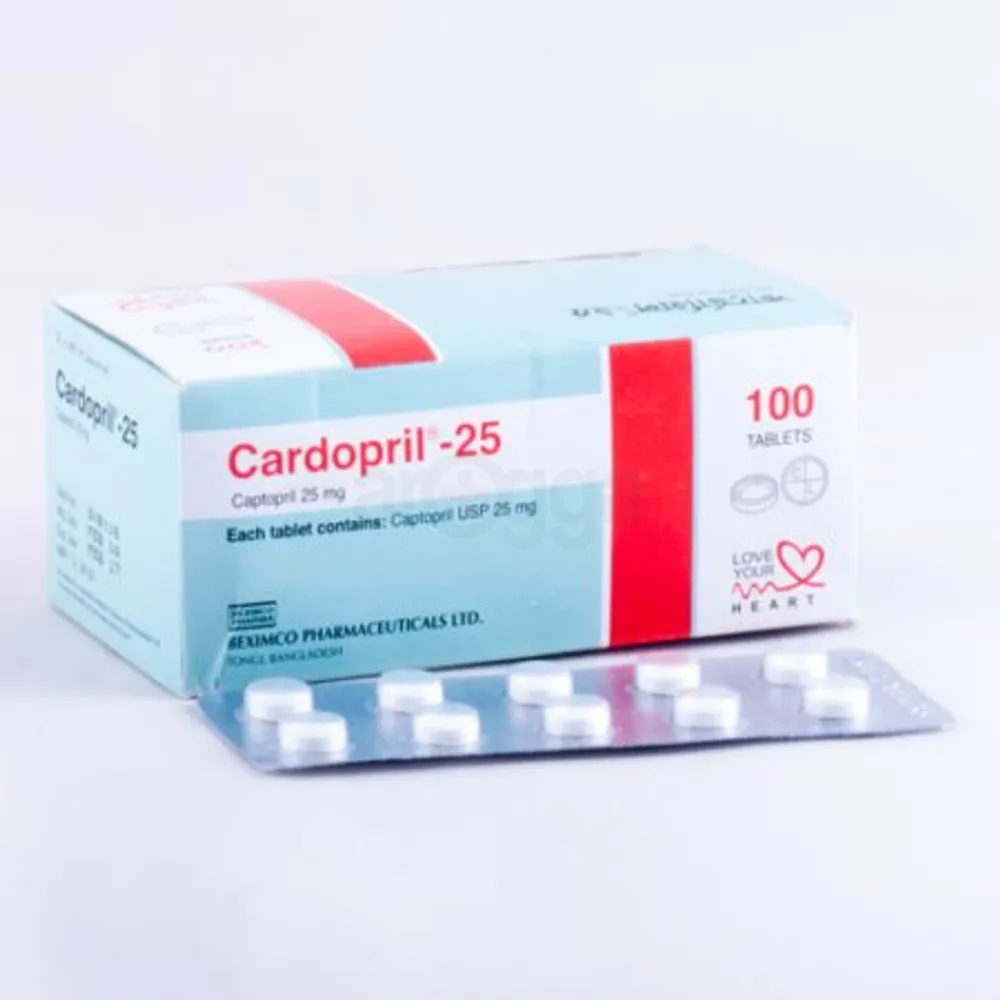

Medicine Overview of Cardopril 25mg Tablet
Cardopril 25 belongs to a group of medicines known as angiotensin converting enzyme (ACE) inhibitors. It is widely used to treat high blood pressure and heart failure and may be prescribed after a heart attack. It also lowers the chances of having a heart attack or stroke.
Cardopril 25 can be prescribed either alone or in combination with other medicines. It may be taken empty stomach. This medicine should be taken at the same time each day to get the most benefit. It is important to continue taking it regularly even if you feel well or even if your blood pressure is controlled. Most people with high blood pressure do not feel ill, but if you stop taking this medicine, your condition could get worse.
Making some changes in your lifestyle will also help lower your blood pressure. These may include regular exercise, losing weight, smoking cessation, reducing alcohol intake, and reducing the amount of salt in your diet as advised by your doctor. The most common side effects of this medicine include feeling dizzy or drowsy, headache, dry cough, fatigue, nausea, vomiting, diarrhea, stomach pain, and low blood pressure. Most of these are temporary and resolve with time. Talk to your doctor if any of the side effects bother you or do not go away.
Before taking this medicine, let your doctor know if you have any kidney or liver problems. Pregnant or breastfeeding mothers should also consult their doctor before taking it. Your doctor may check your kidney function, blood pressure and potassium levels in your blood at regular intervals while you are taking this medicine.
- Hypertension (high blood pressure)
- Prevention of heart attack and stroke
- Heart failure
- Decreased blood pressure
- Cough
- Increased potassium level in blood
- Fatigue
- Weakness
- Dizziness
-
Cardopril 25 can make you feel dizzy for the first few days, so rise slowly if you have been sitting or lying down. You can also prefer taking it at bedtime to avoid dizziness throughout the day.
-
Let your doctor know about any cough, or throat irritation that does not go away.
-
It may increase the level of potassium in blood. Avoid taking potassium supplements and potassium-rich foods such as banana and broccoli.
-
Inform your doctor if you are pregnant, planning pregnancy or breastfeeding.
Adult: PO HTN Initial: 12.5 mg twice daily. Maintenance: 25-50 mg twice daily. Max: 50 mg 3 times/day.
Elderly: Initially, 6.25 mg bid.
Heart failure Initial: 6.25-12.5 mg 2-3 times/day. Max: 50 mg 3 times/day.
Post MI Start 3 days after MI. Initial: 6.25 mg/day, may increase after several wk to 150 mg/day in divided doses if needed and tolerated.
Diabetic nephropathy 25 mg 3 times/day.
Oral
Hypertension
Child: Neonates and infants: 0.15 mg/kg. Max: 6 mg/kg in 2 or 3 divided doses according to response. Childn and adolescents: 0.3 mg/kg. Max: 6 mg/kg in 2 or 3 divided doses according to response.
Heart failure
Child: Initially, 0.25 mg/kg/day, increased up to 2.5 or 3.5 mg/kg/day in 3 divided doses.
Renal impairment:
CrCl (ml/min)
<10 Initially, 6.25 mg/day. Max: 37.5 mg/day.
10-20 Initially, 12.5 mg/day. Max: 75 mg/day.
21-40 Initially, 25 mg/day. Max: 100 mg/day.
Patients on diuretics or with sodium depletion should discontinue diuretics or increase sodium intake prior to initiation of therapy. Renal impairment, SLE and other autoimmune collagen disorders and during concurrent use of immunosuppressant or leucopenic drugs, monitor WBC count and urinary protein before and during therapy. Lactation. Porphyria. Severe CHF.
Discontinue as soon as pregnancy detected; during the second and third trimesters of pregnancy, drugs that act directly on the renin-angiotensin have been associated with fetal injury that includes hypotension, neonatal skull hypoplasia, anuria, reversible or irreversible renal failure, and death
Lactation: enters breast milk/not recommended (AAP states compatible with nursing)
>10%
Hyperkalemia (1-11%)
1-10%
Hypersensitivity rxns (4-7%),Skin rash (4-7%),Dysgeusia (2-4%),Hypotension (1-2.5%),Pruritus (2%),Cough (0.5-2%),Chest pain (1%),Palpitations (1%),Proteinuria (1%),Tachycardia (1%)
Frequency Not Defined
Cardiac arrest,Orthostatic hypotension,Ataxia,Confusion,Depression,Somnolence,Angioedema,Photosensitivity,Neutropenia,ARF if renal artery stenosis,Renal impairment,Impotence
Potentially Fatal: Neutropenia, usually occurs within 3 mth of starting therapy especially in patients with renal dysfunction or collagen diseases. Hyperkalaemia. Anaphylactic reactions.
Pregnancy Category: C; D in 2nd & 3rd trimesters
Discontinue as soon as pregnancy detected; during the second and third trimesters of pregnancy, drugs that act directly on the renin-angiotensin have been associated with fetal injury that includes hypotension, neonatal skull hypoplasia, anuria, reversible or irreversible renal failure, and death
Lactation: enters breast milk/not recommended (AAP states compatible with nursing)
Concurrent treatment w/ NSAIDs reduces hypotensive action and increases the risk of nephrotoxicity. Additive hyperkalaemic effect w/ K supplements, K-sparing diuretics, and other drugs (e.g. heparin). May increase risk of leucopenia w/ procainamide, allopurinol, cytostatic or immunosuppressants. May increase risk of lithium toxicity. Increased risk of nitritoid reactions w/ gold (Na aurothiomalate).
Potentially Fatal: Increased risk of hypotension, hyperkalaemia, and changes in renal function (including acute renal failure) w/ aliskiren in diabetic patients.






Reviews
Clear filtersThere are no reviews yet.