



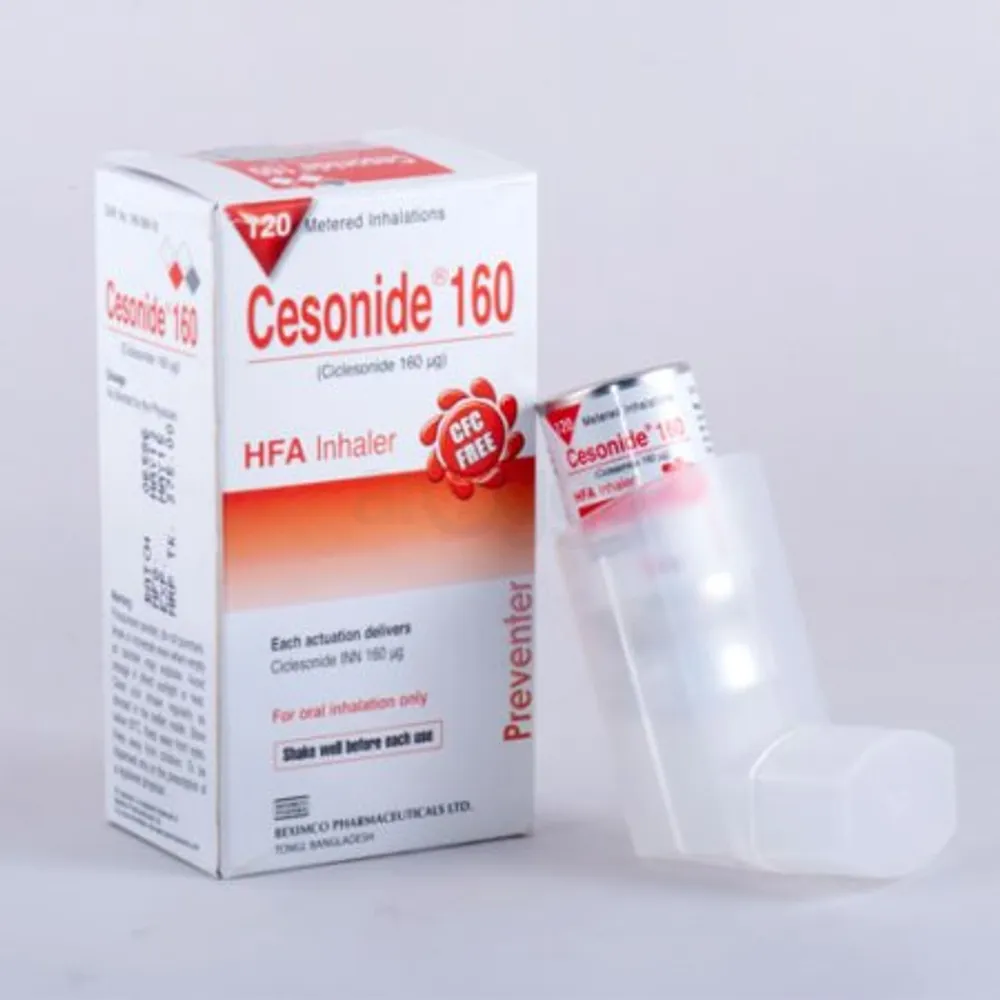

Medicine Overview of Cesonide 160 HFA 160mcg Inhaler
Cesonide 160 HFA is used to prevent the symptoms of asthma (wheezing and shortness of breath). It is a corticosteroid and is known as a “preventer”. You need to have a fast-acting “reliever” as well because this medicine will not stop an asthma attack that has already started.
Your doctor will tell you how often you need to use your inhaler. It is important that you take the lowest dose needed to effectively control your asthma. The effect of this medicine may be noticeable after a few days but will only reach its maximum after a few weeks. This medicine must be used regularly to be effective, so go on taking it even if you do not have any symptoms. That means it is doing its job. If you stop taking it your asthma may get worse. It should not be used to relieve sudden asthma attacks. If an asthma attack occurs, use your quick-relief inhaler (reliever). To get the benefit from this medicine you need to make sure you get your inhaler technique right, otherwise it will not work as well.
The most common side effects are hoarseness of voice, sore throat and oral infections in the mouth or throat. If you get these, do not stop taking it but do talk to your doctor. You can help prevent these symptoms by rinsing your mouth and throat with water or brushing your teeth after using your inhaler. There are other, rarer side effects which can be serious. Talk to your doctor if you are worried about them. In general, you should be trying to avoid situations which make your asthma worse (your triggers) and try not to smoke.
Before taking Cesonide 160 HFA, you should tell your doctor if you have tuberculosis, any infections in your mouth or lungs, or liver disease. While taking it you may be more at risk of getting infections so stay away from people with colds and flu. If you use Cesonide 160 HFA for a long time it may cause weak bones (osteoporosis) and damage to your eyes (glaucoma or cataracts). You might need tests for bone density and eye pressure. Ask your doctor whether it is safe to take this medicine if you are pregnant or breastfeeding.
- Asthma
- Hoarseness of voice
- Sore throat
- Oral infections
-
Cesonide 160 HFA ‘dampens down’ inflammation in the lungs to provide long-term (maintenance) treatment of asthma and prevent disease progression.
-
Cesonide 160 HFA will not work for an ongoing asthma attack. Use your rescue inhaler to control sudden difficulty in breathing.
-
Learn the correct technique of using metered dose inhalers (MDI) and dry powder inhalers (DPI) to ensure that the right amount of medication reaches your lungs, and side effects are minimized.
-
Gargle with warm water after each inhalation to avoid any fungal infections in your mouth and throat.
-
Take it at the same time every day to prevent asthma attacks.
-
Do not open and close the cover unnecessarily as you will lose the medicine.
-
Never breathe out into the mouthpiece.
-
Only minuscule amounts of Cesonide 160 HFA may get absorbed into the bloodstream after inhalation. Hence, serious side effects such or weight gain are unlikely.
Inhalation
Asthma
Adult: Usual dose 160 mcg once daily, preferably in the evening from a metered-dose inhaler; reduced to 80 mcg once daily for maintenance.
May increase to 160 mcg twice daily
Nasal Spray:
1 spray (50 micrograms/spray) in each nostril once a day. The maximum total daily dosage should not exceed 2 sprays in each nostril (200 micrograms/day).
Inhalation
Asthma
Child: >12 yr: Usual dose 160 mcg once daily, preferably in the evening from a metered-dose inhaler; reduced to 80 mcg once daily for maintenance.
May increase to 160 mcg twice daily
Nasal Spray:
1 spray (50 micrograms/spray) in each nostril once a day. The maximum total daily dosage should not exceed 2 sprays in each nostril (200 micrograms/day).
Active or quiescent pulmonary TB, fungal, viral or bacterial infections, unless adequately treated. Severe hepatic impairment. Monitor height of children and adolescents on long term treatment with inhaled corticosteroids; reduce dose if growth is slow. Pregnancy, lactation.
Ciclesonide nasal spray should be used with caution in patients with active or quiescent tuberculosis infection of the respiratory tract or in patients with untreated fungal, bacterial or systemic viral infections or ocular herpes simplex. Rare instances of nasal septal perforation, cataract, and glaucoma have been reported following intranasal application. Development of localized infections of the nose and pharynx with Candida albcans has rarely occurred. Although systemic effects have been minimal with recommended doses of Ciclesonide nasal spray, potential risk increases with larger doses. Therefore, larger than recommended doses of Ciclesonide nasal spray should be avoided.
Lactation: Not known if excreted in breast milk, use caution
Inhalation
>10%
Headache (11%),Nasopharyngitis (11%)
1-10%
Epistaxis (4.9%),Ear pain (2.2%),Facial edema (3%),Urticaria (3%),Oral candidiasis (3%),Back pain (3%),Extremety pain (3%),Conjunctivitis (3%),Upper respiratory infection (9%),Gastroenteritis (3%),Sinusitis (3%)
Nasal spray
1-10%
Headache (3.1-6.6%),Epistaxis (2.9-6%),Nasopharyngitis (3.7%),Nasal discomfort (3.2%),Ear pain (2.2%)
Pregnancy Category: C
Lactation: Not known if excreted in breast milk, use caution


Reviews
Clear filtersThere are no reviews yet.