


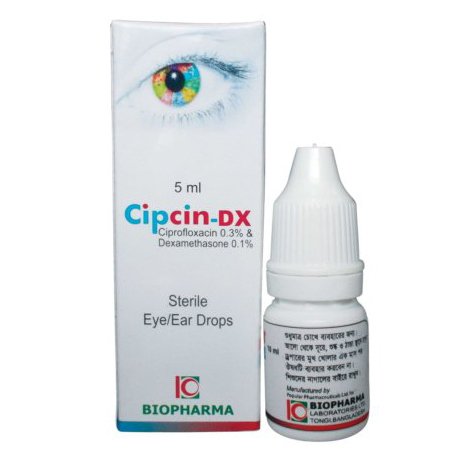

Medicine Overview of Cipcin-DX 0.3%+0.1% Eye/Ear Drops
Cipcin-DX is a prescription medicine having a combination of medicines that is used to treat bacterial infections of the eye or ear. It stops the growth of the bacteria.
Cipcin-DX is to be used only in the affected eye or ear in the dose and duration as advised by the doctor. Wash your hands before using this medicine. It is advised to check the label for directions before use. Do not skip any doses and finish the full course of treatment even if you feel better. Stopping the medicine too early may lead to the infection returning or worsening.
The most common side effects include irritation at the application site. If this side effect persists for a longer duration, inform your doctor. In case by accident, this medicine goes into your nose or mouth, immediately rinse it with water. Inform your doctor if you are pregnant or breastfeeding or are allergic to this medicine or taking any other medication. It is advised not to drive or operate heavy machinery after use of this medicine in the eye as it may cause blurring of vision and may affect your ability to drive.
- Eye infection with inflammation
- Application site irritation
-
Ciplox D Eye/Ear Drops is used to treat bacterial infections and inflammation of the eye/ear.
-
Do not skip any doses and finish the full course of treatment even if you feel better. Stopping it early may make the infection come back and harder to treat.
-
Do not touch the tip to any surface to avoid contamination.
-
Wait for at least 5-10 minutes before delivering the next medication to avoid dilution.
-
Do not use it more often or for longer than advised by your doctor. Inform your doctor if your condition hasn’t improved after seven days of treatment.
-
Make sure to use within 4 weeks of opening the bottle.
For Eye: 1 drop to be instilled into conjunctival sac(s) every four to six hours. During the initial 24 to 48 hours, the dosage may be increased to 1 drop every two hours.
For Ear: Acute otitis externa: 4 drops instilled into the affected ear 2 times daily for 7 days.
Frequency should be decreased gradually or warranted in clinical signs. Care should be taken not to discontinue therapy prematurely.
For Eye: 1 drop to be instilled into conjunctival sac(s) every four to six hours. During the initial 24 to 48 hours, the dosage may be increased to 1 drop every two hours.
For Ear: Acute otitis media in pediatric patients with typanastomy tube: 4 drops instilled into the affected ear 2 times daily for 7 days.
Frequency should be decreased gradually or warranted in clinical signs. Care should be taken not to discontinue therapy prematurely.
<6 months: Not recommended
Ciprofloxacin promotes breakage of double-stranded DNA in susceptible organisms and inhibits DNA gyrase, which is essential in reproduction of bacterial DNA.
Dexamethasone is a synthetic glucocorticoid which decreases inflammation by inhibiting the migration of leukocytes and reversal of increased capillary permeability. It suppresses normal immune response.
Prolonged use may result in overgrowth of nonsusceptible organisms including fungi; in ocular hypertension and/or glaucoma, with damage to the optic nerve, defects in visual acuity and fields of vision and posterior sub capsular cataract formation.
Patients wearing contact lenses must not use the drops during the time the lenses are worn.
Lactation: Unknown whether drug is excreted in milk; use not recommended
The most frequently reported drug-related adverse reactions seen with Ciprofloxacin are transient ocular burning or discomfort. Other reported reactions include stinging, redness, itching, conjunctivitis/keratitis, periocular/facial edema, foreign body sensation, photophobia, blurred vision, tearing, dryness, and eye pain. Rare reports of dizziness have been received.
The reactions due to the steroid component are elevation of intraocular pressure (IOP) with possible development of glaucoma, and infrequent optic nerve damage, posterior sub capsular cataract formation, and delayed wound healing.
Pregnancy category: C
Lactation: Unknown whether drug is excreted in milk; use not recommended
May increase plasma concentrations of CYP1A2 substrates (e.g. clozapine, ropinirole, theophylline). Enhances effect of oral anticoagulants (e.g. warfarin) and glibenclamide. Increased toxicity of methotrexate. Plasma concentrations may be increased by probenecid. Reduced absorption w/ oral multivitamins and mineral supplements containing divalent or trivalent cations (e.g. Fe, Zn, Ca) and antacids containing Al, Ca or Mg. Concomitant use w/ class IA antiarrhythmics (e.g. quinidine, procainamide), class III antiarrhythmics (e.g. amiodarone, sotalol), TCAs, macrolides and antipsychotics may result in additive effects on QT interval prolongation. Concurrent use w/ corticosteroids may increase risk of severe tendon disorders. Increased risk of CNS stimulation w/ NSAIDs. Altered serum concentrations of phenytoin.
Potentially Fatal: Marked elevation in serum levels of tizanidine which is associated w/ potentiated hypotensive and sedative effect.




Reviews
Clear filtersThere are no reviews yet.