

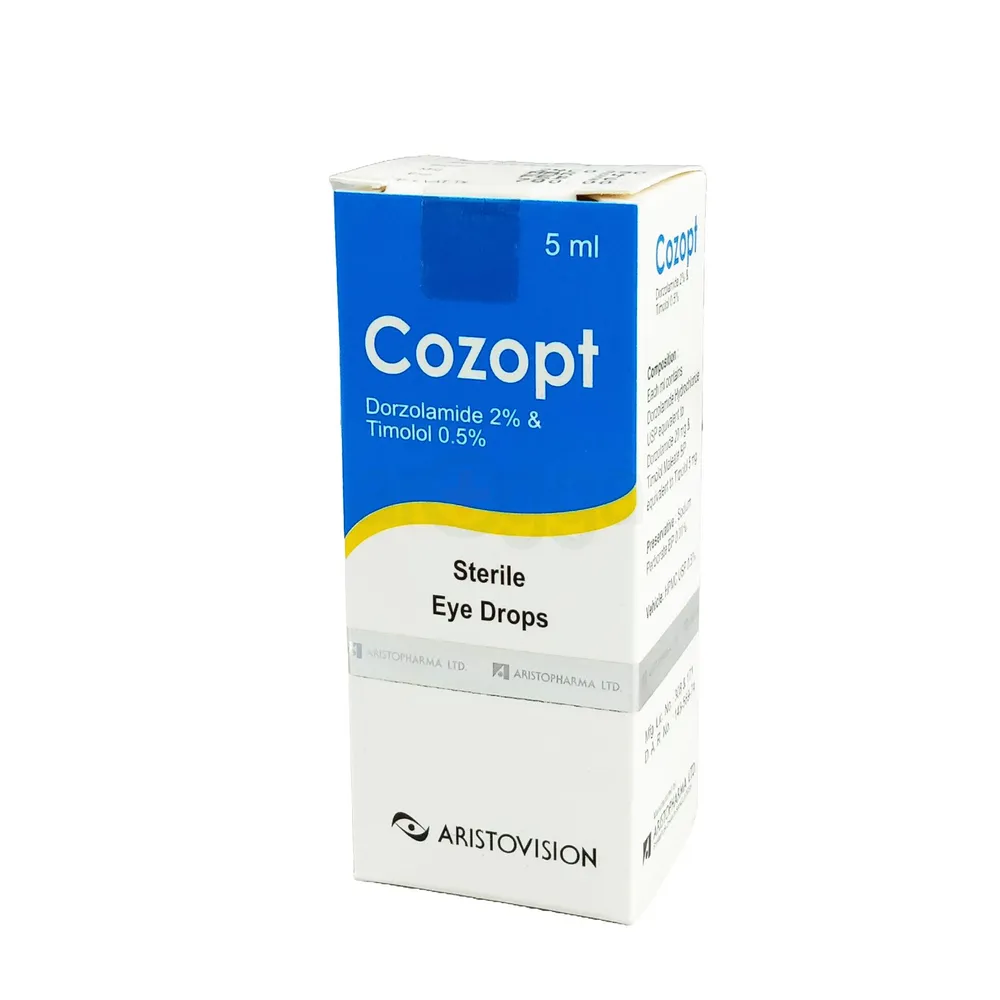

Medicine Overview of Cozopt (2gm+500mg)/100ml Eye Drop
Cozopt is a medicine used to reduce pressure in the eyes. This pressure can be caused by or lead to an illness called glaucoma. If the pressure in your eye is too high it can damage your sight. Cozopt works by decreasing the amount of fluid inside the eye.
Never use Cozopt if the seal is broken before you use it for the first time. Wash your hands before using it and shake the bottle well before each use. Make sure you remove contact lenses if you wear them and wait for at least 15 minutes before putting them back. Do not stop using this medicine without asking your doctor. Otherwise the pressure in your eye will not be controlled and this could damage your sight.
The most common side effects of Cozopt are blurred vision and bitter taste in your mouth. Sometimes people experience more general effects such as headache, nausea, tiredness or eye irritation. If your vision is blurred or you have other changes in sight for a time, do not drive until your vision is clear.
Do not use this medicine if you have severe kidney problems or are allergic to medicines called sulphonamides. Talk to your doctor before taking it if you have liver problems, dry eyes or cornea problems. Do not use other eye medications unless your doctor tells you to.
- Glaucoma
- Headache
- Nausea
- Fatigue
- Burning sensation
- Bitter taste
-
Cozopt helps lower high pressure in the eye and reduce the risk of vision loss.
-
For best results, put one drop 2-3 times daily in the affected eye(s).
-
Apply pressure on the corner of the eye (close to the nose) for about 1 minute, immediately after instilling the drop. This minimizes the risk of side effects.
-
Do not touch the tip of the dropper to any surface, or to your eye, to avoid contaminating the eye drops.
-
Remove contact lenses before using Cozopt, and wait at least 15 minutes before re-inserting them.
-
When applying multiple eye medications, wait for at least 5-15 minutes before delivering the next medication in the same eye to avoid dilution of the medicine.
Ophthalmic
Ocular hypertension; Open-angle glaucoma
Adult: Instill 1 drop to the affected eye bid.
Ophthalmic
Ocular hypertension; Open-angle glaucoma
<2 years
Contraindicated
>2 years
Instill 1 drop to the affected eye bid.
Renal impairment:
CrCl (ml/min)
<30 Not recommended.
Hypersensitivity to any of the components or sulphonamide. History or current bronchial asthma, severe COPD, sinus bradycardia, 2nd or 3rd degree AV block, overt cardiac failure, cardiogenic shock, CrClr <30 ml/min and hyperchloraemic acidosis.
Timolol maleate, a nonselective beta-adrenergic blocker, reduces aqueous humor formation. Dorzolamide, a carbonic anhydrase inhibitor, has actions similar to acetazolamide.
By inhibiting carbonic anhydrase in the ciliary processes of the eye, dorzolamide decreases aqueous humor secretion. Used together, there is additional intraocular pressure reduction compared to using either component alone, but the reduction is not as much as concomitant admin of dorzolamide tid and timolol bid.
Hepatic impairment, mild to moderate renal impairment, children <2 yr. Avoid use in pregnancy and lactation. Prinzmetal’s angina, cardiac disease, hypotension, myasthenia gravis, history of renal calculi, history of intra-ocular surgery, pre-existing chronic corneal defects. May worsen severe peripheral and central circulatory disorders. May mask symptoms of hypoglycaemia and hyperthyroidism. Withdraw gradually, especially in patients with coronary heart disease. Discontinue treatment at the first signs or symptoms of cardiac failure. Contact lenses to be removed before eyedrop application and wait at least 15 minutes before reinsertion. Apply other eyedrops 10 minutes apart. May affect ability to drive or operate machinery as it may cause blurred vision.
Lactation: Excreted in breast milk; not recommended
>10%
Dorzolamide
Ocular burning, stinging, discomfort (33%),Bitter taste (25%),Superficial punctate keratitis (10-15%),Ocular allergic reactions (10%)
Frequency Not Defined
Dorzolamide,Blurred vision,Ocular dryness,Photophobia,Ocular redness,Tearing,Stevens-Johnson syndrome,Toxic epidermal necrolysis
Timolol
Arrythmia,Bradycardia,Syncope,Fatigue,Headache,Dyspnea,Bronchospasm,Chest pain,Edema,Paresthesia,Nausea,Rales,Depression,Decreased exercise tolerance,Raynaud’s phenomenon
Potentially Fatal: Cardiac failure, bronchospasm.
Pregnancy Category: C
Lactation: Excreted in breast milk; not recommended

Reviews
Clear filtersThere are no reviews yet.