


Introduction
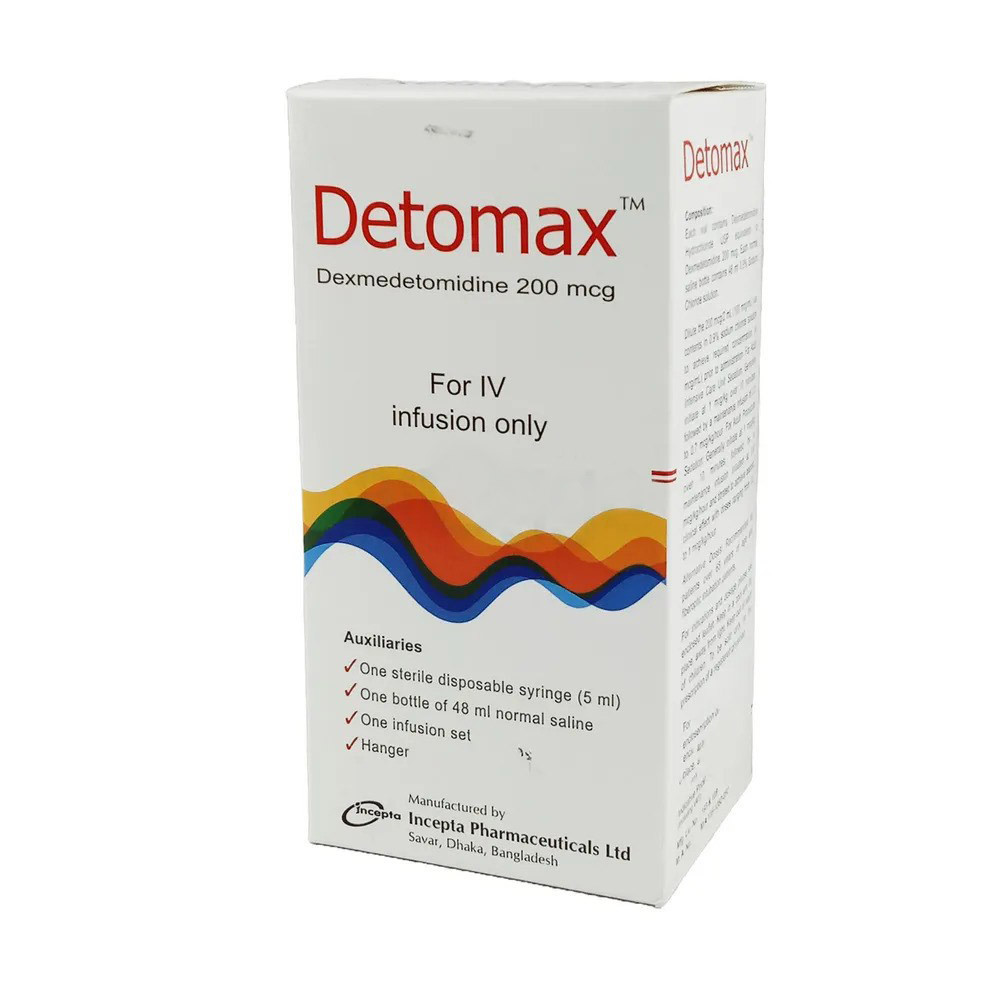
Detomax is a prescription medicine used to provide sedation (a state of calm, drowsiness, or sleep) for adult patients in intensive care settings. It may also be used for awake sedation during diagnostic and surgical procedures. Detomax is given as an infusion (drip) into a vein under the supervision of a healthcare professional. It is important to inform your doctor if you are suffering from any medical conditions like slow heart rate, low blood pressure, neurological disorder, severe liver problems, or have ever developed a serious fever after some medicines, especially after taking anesthesia. Your doctor will monitor the cardiac and respiratory state after providing this injection. It may cause dryness in mouth, decreased blood pressure and slow heart rate as side effects of this medicine. Please consult your doctor if these side effects do not improve with time or worsen.
_
Uses of Detomax
Sedative
Side effects of Detomax
Common
Decreased blood pressure
Dryness in mouth
How to use Detomax
Your doctor or nurse will give you this medicine. Kindly do not self administer.
How Detomax works
Detomax works by modulating the action of certain chemical messengers in the brain that relieves pain and induces sleep.
Quick Tips
Detomax is given as an infusion into the veins by healthcare professionals only.
Your doctor will closely monitor your heart rate, blood pressure, breathing rate and oxygen level during the treatment.
Inform your doctor if you are pregnant, planning pregnancy or breastfeeding.
Brief Description
Indication
ICU Sedation, Fiberoptic Intubation, Procedural Sedation
Administration
IV Preparation Dilute in NS IV Administration Infuse loading dose over 10 min
_
Adult Dose
ICU Sedation Load: 1 mcg/kg IV over 10 minutes Maintenance 0.2-1.4 mcg/kg/hr IV Titrate less frequently than q30min to prevent hypotension Fiberoptic Intubation Load: 1 mcg/kg IV over 10 minutes Maintenance 0.7 mcg/kg/hr IV Procedural Sedation Load: 1 mcg/kg IV over 10 minutes Maintenance 0.6 mcg/kg/hr IV titrate to effect (usually 0.2-1 mcg/kg/hr) Titrate less frequently than q30min to prevent hypotension Hepatic Impairment Dose reduction may be required
_
Child Dose
Safety and efficacy not established
Renal Dose
Renal Impairment Dose reduction may be required
_
Contraindication
2nd or 3rd degree AV block (unless paced), uncontrolled hypotension, acute cerebrovascular disorders.
Mode of Action
Centrally acting alpha2-adrenoceptor agonist that has sedative and anesthetic properties possibly by activating G-proteins in the brainstem, which results in the inhibition of norepinephrine release.
Precaution
Significant CV dysfunction, advanced heart block &/or severe ventricular dysfunction, hypovolemia, DM, chronic HTN. Renal & hepatic impairment. Do not inj by bolus or rapid IV. Do not administer for >24 hr. Pregnancy & lactation. Elderly. Childn <18 yr. Lactation: Excretion in milk unknown; use with caution
_
Side Effect
>10% Hypotension (28%) 1-10% AFib.Anemia,Bradycardia,Fever,Pleural effusion,Leukocytosis,Pulmonary edema
_
Pregnancy Category Note
Pregnancy There are no adequate and well-controlled studies of use in pregnant women In an in vitro human placenta study, placental transfer of dexmedetomidine occurred Animal studies In pregnant rats, dexmedetomidine placental transfer observed when radiolabeled dexmedetomidine was administered SC Thus, fetal exposure should be expected in humans; use during pregnancy only if potential benefits justify potential fetal risk Lactation Unknown if excreted in human milk Radio-labeled dexmedetomidine administered SC to lactating female rats was excreted in milk Because many drugs are excreted in human milk, caution should be exercised when administered to breastfeeding women
_
Interaction
Enhanced pharmacologic effects of anaesth, sedatives, hypnotics, opiate agonists, other vasodilators or drugs that have negative chronotropic effects (e.g. cardiac glycosides).


Reviews
Clear filtersThere are no reviews yet.