


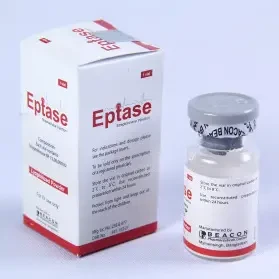

Medicine Overview of Eptase 1.5million Injection
Eptase is a medicine used to break down harmful blood clots that have formed in the blood vessels. It is used to treat patients who have suffered a recent heart attack. It is also used in treating conditions such as pulmonary embolism and stroke.
Eptase is administered under the supervision of a doctor. Your doctor will decide the dose and duration of the medicine for you. The doctor may closely monitor your condition till you became stable.
Use of this medicine may cause injection site bleeding, allergic reaction, and decrease in blood pressure. It may increase your risk of bleeding also. Your doctor will explain the benefits and risks associated with this medicine before it is administered. You should continue all your other medicines that are advised by the doctor for your long-term treatment even after this injection.
This medicine is used with caution for some people. Thus, you must inform the doctor if you are suffering from any bleeding disorder, kidney or liver disease. Also, let your doctor know if you are pregnant or breastfeeding and about all the other medications that you are taking regularly.
- Heart attack
- Pulmonary embolism
- Allergic reaction
- Nausea
- Vomiting
- Injection site bleeding
-
It increases your risk of bleeding. Be careful while shaving, cutting fingernails or toenails, using sharp objects or engaging in contact sports (e.g. football, wrestling).
-
Do not discontinue use without consulting your doctor as this may increase your chances of having another heart attack or stroke.
Intravenous
Acute myocardial infarction
Adult: 1.5 million units as a single dose infused over 1 hr immediately after onset of symptoms.
Pulmonary thromboembolism ; Arteriovenous occlusions
Adult: Loading dose: 250,000 units infused over 30 min. Maintenance: 100,000 units/hr for 24-72 hr depending on the condition to be treated. For cerebral retinal thrombosis, 12 hr may be sufficient. Monitor treatment by maintaining thrombin clotting time at 2-4 times normal values.
Intravenous
Pulmonary thromboembolism ; Arteriovenous occlusions
Child: Loading dose: 2500-4000 units/kg over 30 min, followed by infusion of 500-1000 units/kg/hr, continued until reperfusion occurs, up to 3 days. Initial dose may be estimated by streptokinase resistance test. Monitor treatment by maintaining thrombin clotting time at 2-4 times normal values.
Fever, chills, back pain, abdominal pain, nausea, vomiting, arrhythmia, bruising, rash, pruritus, acute renal failure due to embolism and haemorrhage. Cerebral, peripheral and pulmonary embolism. Allergic reactions, liver enzyme abnormalities, hypotension.
Potentially Fatal: Haemorrhage; anaphylactic shock.
Antagonistic effects with antifibrinolytic agents e.g. aminocaproic acid.
Potentially Fatal: Anticoagulants, heparin, antiplatelet agents e.g. aspirin and dipyridamole affect platelet function increasing the risk of haemorrhage.


Reviews
Clear filtersThere are no reviews yet.