

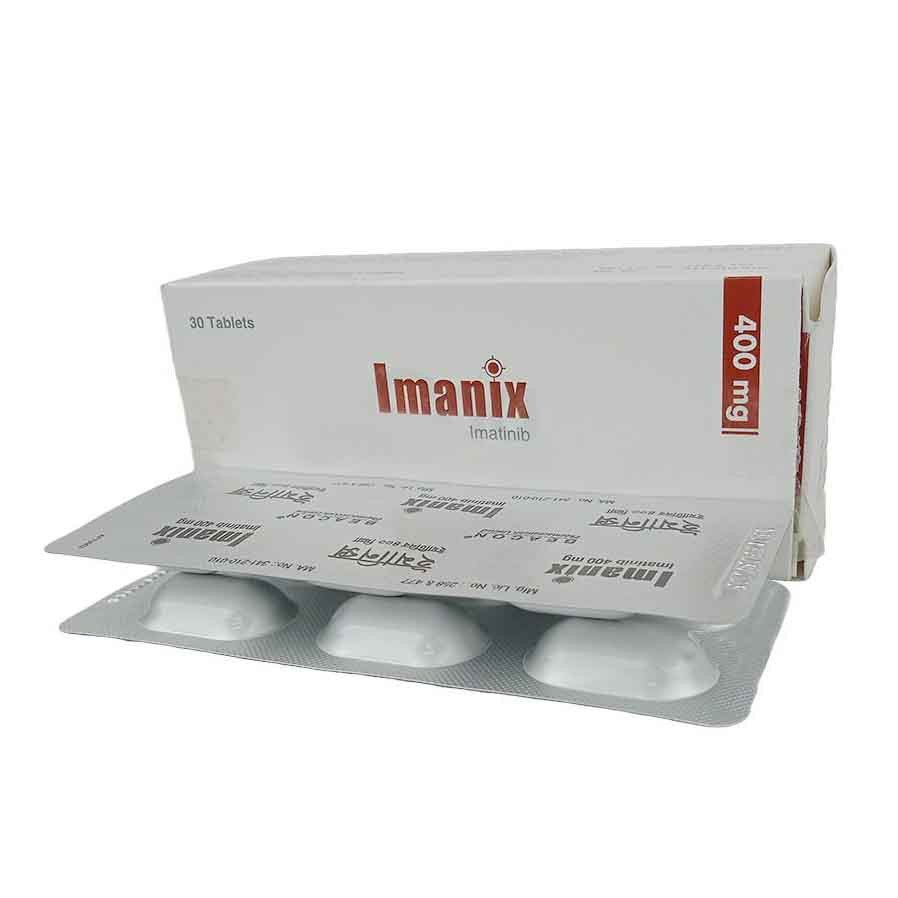

Medicine Overview of Imanix 400mg Tablet
Imanix 400 belongs to the class of medicines known as tyrosine kinase inhibitors. It is used in the treatment of blood cancer (chronic myeloid leukaemia and Acute lymphocytic leukemia) and gastrointestinal stromal tumor.
Imanix 400 should be taken with food, but better to have it same time every day to get the most benefit. You should continue to take it as long as your doctor advises for it. The duration of treatment varies according to your need and response to treatment. Taking it in the wrong way or taking too much can cause very serious side effects. It may take several weeks or months for you to see or feel the benefits but do not stop taking it unless your doctor tells you to.
The most common side effects of this medicine include rash, vomiting, abdominal pain and diarrhea. Other than this, water retention and swelling are commonly observed side effects. Let your doctor know if you experience unexpected rapid weight gain. Your doctor may advice for regular monitoring of blood cells and liver function while you are taking this medicine. Do not drive or do anything requiring mental focus if you experience dizziness and blurry vision.
Many other medicines can affect, or be affected by, this medicine so let your healthcare team know all medications you are using. This medicine is not recommended during pregnancy or while breastfeeding. The use of effective contraception by both males and females during treatment is important to avoid pregnancy.
- Blood cancer (Chronic myeloid leukaemia)
- Blood cancer (Acute lymphocytic leukemia)
- Gastrointestinal stromal tumour
- Abdominal pain
- Diarrhea
- Fatigue
- Muscle cramp
- Musculoskeletal (bone, muscle or joint) pain
- Nausea
- Rash
- Vomiting
-
Always take it with food and a full glass of water to prevent nausea.
-
It may cause dizziness or blurred vision. Do not drive or do anything requiring concentration until you know how it affects you.
-
Water retention and swelling are very common side effects of Imanix 400. Notify your doctor if you have unexpected rapid weight gain.
-
Do not change the dose or discontinue use without consulting your doctor.
-
Notify your doctor about all the medications you are taking, including over the counter medicines and dietary supplements.
-
Your doctor may get regular blood tests done to monitor your liver function and the number of blood cells in your blood.
Acute Lymphoblastic Leukemia
Indicated for adults with relapsed or refractory Philadelphia chromosome positive (Ph+) acute lymphoblastic leukemia (ALL)
600 mg PO qDay
Myelodysplastic/Myeloproliferative Diseases
Indicated in adults with myelodysplastic/ myeloproliferative diseases associated with platelet-derived growth factor receptor gene re-arrangements as determined with an FDA-approved test
400 mg PO qDay
Hypereosinophilic Syndrome/Eosinophilic Leukemia
Indicated for adults with hypereosinophilic syndrome and/or chronic eosinophilic leukemia who have the FIP1L1-PDGFR-alpha fusion kinase (mutational analysis or FISH demonstration of CHIC2 allele deletion) and for patients with HES and/or CEL who are FIP1L1-PDGFR-alpha fusion kinase negative or unknown
400 mg PO qDay
In patients with demonstrated F1P1L1-PDGFR-alpha fusion kinase: 100 mg PO qDay; may increase to 400 mg qDay in the absence of adverse drug reactions if assessments demonstrate an insufficient response to therapy
Chronic Myeloid Leukemia
Chronic phase
Newly diagnosed adult and pediatric patients with Philadelphia chromosome positive (Ph+) chronic myeloid leukemia (CML) in chronic phase
400 mg PO qDay
Chronic phase after failure of interferon-alpha therapy: May increase to 600 mg/day in the absence of severe adverse drug reaction and severe nonleukemia related neutropenia or thrombocytopenia in the following circumstances: disease progression (at any time), failure to achieve a satisfactory hematologic response after at least 3 months of treatment, failure to achieve a cytogenetic response after 6-12 months of treatment, or loss of a previously achieved hematologic or cytogenetic response
Accelerated phase or blast crisis
600 mg PO qDay
May increase to 400 mg PO q12hr in the absence of severe adverse drug reaction and severe nonleukemia related neutropenia or thrombocytopenia in the following circumstances: disease progression (at any time), failure to achieve a satisfactory hematologic response after at least 3 months of treatment, failure to achieve a cytogenetic response after 6-12 months of treatment, or loss of a previously achieved hematologic or cytogenetic response
Dermatofibrosarcoma Protuberans
Indicated for adults with unresectable, recurrent and/or metastatic dermatofibrosarcoma protuberans
400 mg PO q12hr
Mastocytosis
Indicated for adults with aggressive systemic mastocytosis without the D816V c-Kit mutation as determined with an FDA-approved test or with c-Kit mutational status unknown
Without D816V c-Kit mutation: 100 mg PO qDay
c-Kit mutational status unknown: 400 mg PO qDay if not responding to other therapies
ASM associated with eosinophilia (a clonal hematological disease related to the fusion kinase FIP1L1-PDGFR-alpha): 100 mg PO qDay initially, may increase to 400 mg/day in absence of adverse effects if response to therapy is insufficient
Gastrointestinal Stromal Tumors
Unresectable and/or metastatic malignant GIST
400 mg PO qDay; may increase to 400 mg BID in patients showing clear signs or symptoms of disease progression at a lower dose and in the absence of severe adverse drug reactions
Adjuvant treatment following complete gross resection of GIST
400 mg PO qDay x3 years
Hepatic impairment: Severe: Reduce dose by 25%.
Chronic Myeloid Leukemia
Indicated for newly diagnosed adult and pediatric patients with Philadelphia chromosome positive (Ph+) chronic myeloid leukemia (CML) in chronic phase
<1 year: Safety and efficacy not established
>1 year: 340 mg/m²/day PO; not to exceed 600 mg/day
Acute Lymphoblastic Leukemia
Indicated for treatment of newly diagnosed children with Philadelphia chromosome positive (Ph+) acute lymphoblastic leukemia (ALL)
<1 year: Safety and efficacy not established
>1 year: 340 mg/m²/day PO; not to exceed 600 mg/day
Cardiac disease or increased risk for CHF. Monitor for signs of severe fluid retention. Monitor CBC regularly. Renal and hepatic impairment. Monitor LFTs. Pregnancy.
Lactation: Imatinib and its active metabolite are excreted into human milk; advise a lactating woman not to breastfeed during treatment and for 1 month after last dose
>10%
Edema (53%),Neutropenia (Grade 3: 7-27%; Grade 4: 3-48%),Nausea (43%),Muscle cramps (35%),Musculoskeletal pain (34%),Thrombocytopenia (Grade 3: 1-31%; Grade 4: 1-34%),Rash (32%),Fatigue (31%),Diarrhea (30%),Headache (29%),Arthralgia (27%),Abd pain (23%),Myalgia (21%),Nasopharyngitis (19%),Hemorrhage (19%),Vomiting (15%),Dyspepsia (15%),Cough (13%),Dizziness (13%),URT infection (13%),Fever (12%),Weight gain (12%),Hepatotoxicity (6-12%),Insomnia (11%)
1-10%
Flushing,Palpitation,Dry skin,Erythema,Metabolic hyperglycemia,Stomatitis/mucositis,Lymphopenia
<1%
Aplastic anemia,Atrial fibrillation,Avascular necrosis,Cardiac failure,Cardiogenic shock,Embolism,Eosinophilia
Potentially Fatal: Hepatotoxicity, cerebral oedema, increased intracranial pressure, papilloedema. Severe fluid retention resulting in pleural and pericardial effusion, pulmonary oedema and ascites. Rarely, GI perforation.


Reviews
Clear filtersThere are no reviews yet.