


Introduction
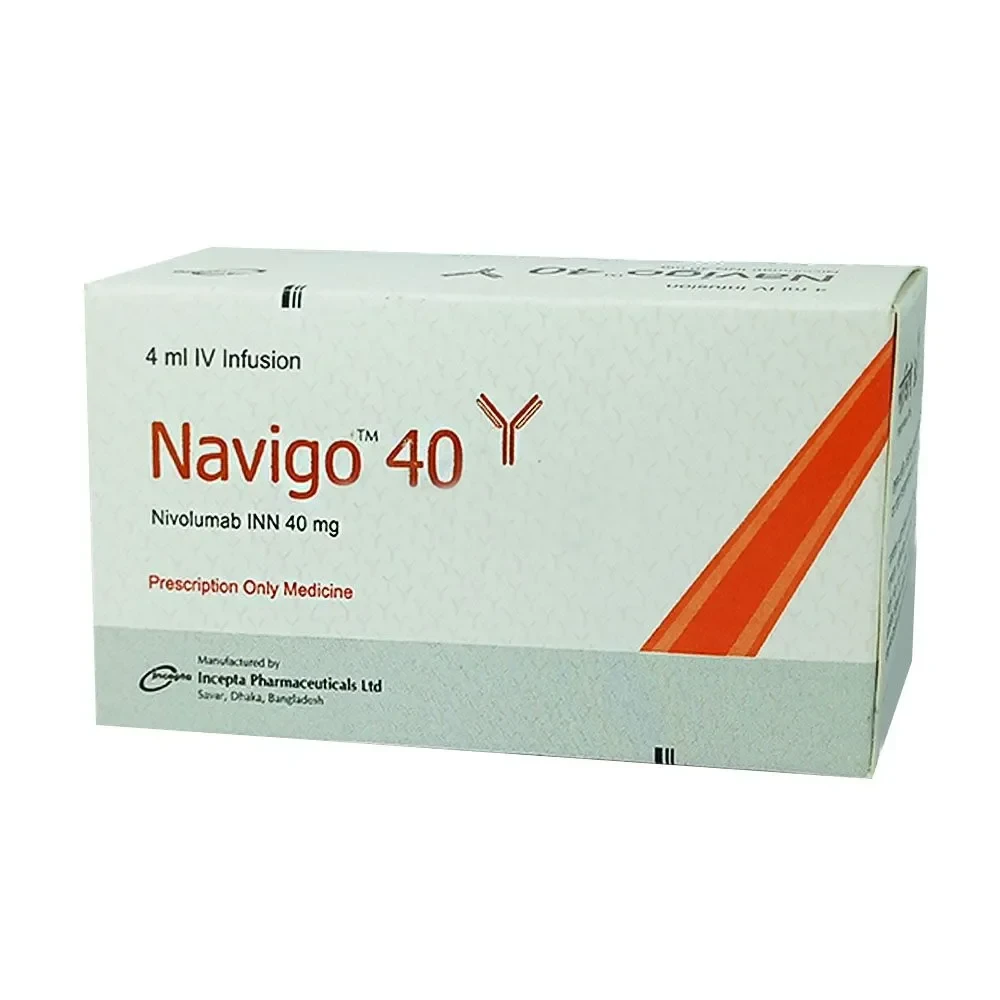
Navigo 40 is used in the treatment of non-small cell lung cancer, kidney cancer, head and neck cancer, melanoma, Hodgkin’s disease, and liver cancer. Navigo 40 is given as an infusion into vein by a qualified medical professional. Your doctor will decide what dose is necessary and how often you need to take it. This will depend on what you are being treated for and may change from time to time. You should take it exactly as your doctor has advised. Taking it in the wrong way or taking too much can cause very serious side effects. It may take several weeks or months for you to see or feel the benefits but do not stop taking it unless your doctor tells you to. Some common side effects of this medicine include rash, weakness, headache, and fever. Some serious side effects which may occur during infusion include chills or shaking, itching, rash, flushing, difficulty breathing and dizziness. Hence, your doctor will check you timely after infusion for allergic reaction. Before taking it, tell your doctor if have lung disease, liver, or kidney problems or are taking any medicines to treat infections. Many other medicines can affect, or be affected by, this medicine so let your healthcare team know all medications you are using. This medicine is not recommended during pregnancy or while breastfeeding. Use of effective contraception by both males and females during treatment is important to avoid pregnancy.
_
Uses of Navigo 40
Non-small cell lung cancer
Kidney cancer
Head and neck cancer
Melanoma
Hodgkin’s disease
Liver cancer
Side effects of Navigo 40
Common
Rash
Weakness
Headache
Fever
Musculoskeletal (bone, muscle or joint) pain
Back pain
Stomach pain
Nausea
Itching
Constipation
Diarrhea
Upper respiratory tract infection
Decreased appetite
Breathlessness
Cough
How to use Navigo 40
Your doctor or nurse will give you this medicine. Kindly do not self administer.
How Navigo 40 works
Navigo 40 is an anti-cancer medication. It works by blocking a protein (PD-1) on the surface of certain immune cells called T-cells. This action activates the T-cells to locate and kill cancer cells.
Brief Description
Description
Nivolumab is a human immunoglobulin G4 (IgG4) monoclonal antibody that binds to the PD-1 receptor and blocks its interaction with PD-L1 and PD-L2, releasing PD-1 pathway-mediated inhibition of the immune response, including the anti-tumor immune response. Combined nivolumab (anti-PD-1) and ipilimumab (anti-CTLA-4) mediated inhibition results in enhanced T-cell function that is greater than the effects of either antibody alone, and results in improved anti-tumor responses in metastatic melanoma and advanced RCC.
Indications
Nivolumab is a programmed death receptor-1 (PD-1)-blocking antibody indicated for:
•Melanoma
•Non-Small Cell Lung Cancer (NSCLC)
•Malignant Pleural Mesothelioma
•Renal Cell Carcinoma (RCC)
•Classical Hodgkin Lymphoma (cHL)
•Squamous Cell Carcinoma of the Head and Neck (SCCHN)
•Urothelial Carcinoma
•Colorectal Cancer
•Hepatocellular Carcinoma (HCC)
•Esophageal Cancer
•Gastric Cancer, Gastroesophageal Junction Cancer, and Esophageal Adenocarcinoma
_
Dosage & Administration
Administer by intravenous infusion after dilution based upon recommended infusion rate for each indication.
Unresectable or metastatic melanoma
• 240 mg every 2 weeks or 480 mg every 4 weeks
• 1 mg/kg followed by ipilimumab 3 mg/kg on the same day every 3 weeks for 4 doses, then
240 mg every 2 weeks or 480 mg every 4 weeks
Adjuvant treatment of melanoma
• 240 mg every 2 weeks or 480 mg every 4 weeks. (2.2)
Neoadjuvant treatment of resectable (tumors ?4 cm or node positive) non-small cell lung cancer
• 360 mg with platinum-doublet chemotherapy on the same day every 3 weeks for 3 cycles
Metastatic non-small cell lung cancer
• 360 mg every 3 weeks with ipilimumab 1 mg/kg every 6 weeks
• 360 mg every 3 weeks with ipilimumab 1 mg/kg every 6 weeks and 2 cycles of platinum-doublet
chemotherapy
• 240 mg every 2 weeks or 480 mg every 4 weeks
Malignant pleural mesothelioma
• 360 mg every 3 weeks with ipilimumab 1 mg/kg every 6 weeks
Advanced renal cell carcinoma
• 3 mg/kg followed by ipilimumab 1 mg/kg on the same day every 3 weeks for 4 doses, then
240 mg every 2 weeks or 480 mg every 4 weeks
• 240 mg every 2 weeks or 480 mg every 4 weeks administered in combination with
cabozantinib 40 mg once daily without food
• 240 mg every 2 weeks or 480 mg every 4 weeks
Classical Hodgkin lymphoma
• 240 mg every 2 weeks or 480 mg every 4 weeks
Recurrent or metastatic squamous cell carcinoma of the head and neck
• 240 mg every 2 weeks or 480 mg every 4 weeks
Adjuvant treatment of urothelial carcinoma
• 240 mg every 2 weeks or 480 mg every 4 weeks
Locally advanced or metastatic urothelial carcinoma
• 240 mg every 2 weeks or 480 mg every 4 weeks
Microsatellite instability-high (MSI-H) or mismatch repair deficient (dMMR) metastatic colorectal cancer
• Adult and pediatric patients weighing 40 kg or greater: 240 mg every 2 weeks or 480 mg every
4 weeks
• Pediatric patients weighing less than 40 kg: 3 mg/kg every 2 weeks
• Adult and pediatric patients weighing 40 kg or greater: 3 mg/kg followed by ipilimumab 1 mg/kg on the same
day every 3 weeks for 4 doses, then 240 mg every 2 weeks or 480 mg every 4 weeks
Hepatocellular carcinoma
• 1 mg/kg followed by ipilimumab 3 mg/kg on the same day every 3 weeks for 4 doses, then
240 mg every 2 weeks or 480 mg every 4 weeks
Adjuvant treatment of resected esophageal or gastroesophageal cancer
• 240 mg every 2 weeks or 480 mg every 4 weeks for total treatment duration of 1 year
Esophageal squamous cell carcinoma
• 240 mg every 2 weeks or 480 mg every 4 weeks in combination with chemotherapy regimen of
fluoropyrimidine- and platinum-containing chemotherapy
• 3 mg/kg every 2 weeks or 360 mg every 3 weeks with ipilimumab 1 mg/kg every 6 weeks
• 240 mg every 2 weeks or 480 mg every 4 weeks
Gastric cancer, gastroesophageal junction cancer, and esophageal adenocarcinoma (GC, GEJC, or EAC)
• 360 mg every 3 weeks with fluoropyrimidine- and platinum-containing chemotherapy every 3 weeks
• 240 mg every 2 weeks with fluoropyrimidine- and platinum-containing chemotherapy every 2 weeks
Preparation and Administration
• The required volume of Nivolumab should be withdrawn and transfer into an intravenous container
• Nivolumab should be diluted with either 0.9% Sodium Chloride Injection, USP or 5% Dextrose Injection, USP to
prepare an infusion with a final concentration ranging from 1 mg/mL to 10 mg/mL. The total volume of
infusion must not exceed 160 mL.
• For adult and pediatric patients with body weight 40 kg or greater, total volume of infusion should not exceed
160 mL.
• For adult and pediatric patients with body weight less than 40 kg, total volume of infusion should not exceed
4 mL/kg of body weight.
• Diluted solution should be mixed by gentle inversion and should not be shaken
• Partially used vials or empty vials of NAVILUMAB should be discarded
• The product does not contain a preservative
• After preparation, the diluted solution should be stored either:
• At room temperature and room light for not more than 8 hours from the time of
preparation to end of the infusion. Diluted solution should be discarded if not used
within 8 hours from the time of preparation; or
• Under refrigeration at 2°C to 8°C (36°F to 46°F) and protected from light for not more
than 7 days from the time of preparation to end of infusion. Diluted solution should
be discarded if not used within 7 days from the time of preparation.
• Should not be frozen
• Administer the infusion, after dilution, over 30 minutes through an intravenous line containing a sterile,
non-pyrogenic, low protein binding in-line filter (pore size of 0.2 micrometer to 1.2 micrometer).
• Do not co-administer other drugs through the same intravenous line.
_
Side Effects
Most common adverse reactions (incidence ?20%) in patients were:
• As a single agent: fatigue, rash, musculoskeletal pain, pruritus, diarrhea, nausea, asthenia, cough, dyspnea,
constipation, decreased appetite, back pain, arthralgia, upper respiratory tract infection, pyrexia, headache,
abdominal pain, vomiting, and urinary tract infection
• In combination with ipilimumab: fatigue, diarrhea, rash, pruritus, nausea, musculoskeletal pain, pyrexia,
cough, decreased appetite, vomiting, abdominal pain, dyspnea, upper respiratory tract infection, arthralgia,
headache, hypothyroidism, constipation, decreased weight, and dizziness
• In combination with platinum-doublet chemotherapy: nausea, constipation, fatigue, decreased appetite, and
rash
• In combination with cabozantinib: diarrhea, fatigue, hepatotoxicity, palmar-plantar erythrodysaesthesia
syndrome, stomatitis, rash, hypertension, hypothyroidism, musculoskeletal pain, decreased appetite, nausea,
dysgeusia, abdominal pain, cough and upper respiratory tract infection
• In combination with fluoropyrimidine- and platinum-containing chemotherapy: nausea,
peripheral neuropathy, decreased appetite, fatigue, constipation, stomatitis, diarrhea,
vomiting, abdominal pain, and musculoskeletal pain
_
Precautions
• Immune-mediated adverse reactions, which may be severe or fatal, can occur in any organ system or tissue,
including the following: immune-mediated pneumonitis, immune-mediated colitis, immune-mediated
hepatitis and hepatotoxicity, immune-mediated endocrinopathies, immune-mediated dermatologic adverse
reactions, and immune-mediated nephritis and renal dysfunction
• Monitor for early identification and management. Evaluate liver enzymes, creatinine, and thyroid function at
baseline and periodically during treatment. Withhold or permanently discontinue based on severity and type
of reaction
• Infusion-related reactions: Interrupt, slow the rate of infusion, or permanently discontinue Nivolumab based
on severity of reaction
• Complications of allogeneic HSCT: Fatal and other serious complications can occur in patient who receive
allogeneic HSCT before or after being treated with a PD-1/PD-L1 blocking antibody
• Embryo-Fetal toxicity: Can cause fetal harm. Advise females of reproductive potential of potential risk to a
fetus and to use effective contraception
• Treatment of patients with multiple myeloma with a PD-1 or PD-L1 blocking antibody in combination with a
thalidomide analogue plus dexamethasone is not recommended outside of controlled clinical trials.
_
Use in Pregnancy & Lactation
Pregnancy: Nivolumab can cause fetal harm when administered to a pregnant woman.
Lactation: There are no data on the presence of nivolumab in human milk, the effects on the breastfed child, or
the effects on milk production.
Contraception: Based on its mechanism, Nivolumab can cause fetal harm when administered to a pregnant
woman. Advise females of reproductive potential to use effective contraception during treatment with Nivolumab
and for at least 5 months following the last dose of Nivolumab.
Pediatric Use: The safety and effectiveness of Nivolumab have not been established in pediatric patients less
than 12 years old with MSI-H or dMMR mCRC or in pediatric patients less than 18 years old for the other
approved indications.
Geriatric Use: No overall difference in safety was reported between elderly patients and younger patients. In
elderly patients with intermediate or poor risk, no overall difference in effectiveness was reported.
_
Storage
Store at 2-8° C (in a refrigerator). Do not freeze. Keep away from light and out of reach of children.


Reviews
Clear filtersThere are no reviews yet.