



Introduction
Neoclomide is used in the treatment of different kinds of cancers. It is also used to treat kidney disease known as nephrotic syndrome in children after other treatments have not worked. It may be also used to treat other conditions, as determined by the doctor. Neoclomide should be taken with food preferably in morning but at the same time every day to get the most benefit. Your doctor will decide what dose is necessary and how often you need to take it. This will depend on what you are being treated for and may change from time to time. You should take it exactly as your doctor has advised. Taking it in the wrong way or taking too much can cause very serious side effects. It may take several weeks or months for you to see or feel the benefits but do not stop taking it unless your doctor tells you to. The most common side effects of this medicine include vomiting, nausea, hair loss, fever, and blood in urine. If they do not go away or get worse, tell your doctor. There may be ways of preventing or reducing these effects. It is very strong medicine and some people may develop serious side effects while taking it. This medicine may lower your ability to fight infections and lead to problems with your blood, liver or kidneys. Your doctor will advise you regular blood tests to check for these. It is advised that you drink extra fluids so that you pass more urine. This will help prevent bladder and kidney problems and keep your kidneys working well. Before taking it, tell your doctor if you have liver, or kidney problems or are taking any medicines to treat infections. Many other medicines can affect, or be affected by, this medicine so let your doctor know all medications you are using. This medicine is not recommended during pregnancy or while breastfeeding. It may harm your baby. The use of effective contraception by both males and females during treatment is important to avoid pregnancy.
_
Uses of Neoclomide
Cancer
Nephrotic syndrome
Side effects of Neoclomide
Common
Vomiting
Nausea
Hair loss
Fever
Blood in urine
Diarrhea
Decreased white blood cell count (neutrophils)
How to use Neoclomide
Take this medicine in the dose and duration as advised by your doctor. Swallow it as a whole. Do not chew, crush or break it. Neoclomide is to be taken with food.
How Neoclomide works
Neoclomide is an anti-cancer medication. It is an alkylating agent which works by damaging the genetic material (DNA and RNA) of the cancer cells, thereby stopping their growth and multiplication. This is how it works against cancer.
Quick Tips
Neoclomide helps in the treatment of cancer.
Drink plenty of fluids or urinate frequently to prevent urinary problems while taking this medication.
Take it with food if you experience irritation of the stomach, preferably in the morning.
Your doctor may get regular blood tests to monitor your blood counts while on treatment with this medication.
You are more likely to get sick or heal slower while taking this medication. Talk to your doctor before getting any vaccines.
Contact your doctor immediately if you experience difficulty in urinating or blood in urine while on treatment with this medication.
Do not take Neoclomide if you are pregnant or breastfeeding.
Use effective contraception method to prevent pregnancy while taking this medicine.
Brief Description
Indication
Bone marrow transplantation, malignancies, lymphomas, brain cancer, leukemia, systemic lupus erythematosus, minimal change disease, severe rheumatoid arthritis, wegener’s granulomatosis, multiple sclerosis, multiple myeloma, carcinoma of the breast, ovarian carcinoma, neuroblastoma, retinoblastoma.
_
Administration
Should be taken on an empty stomach. Preferably taken on an empty stomach, but may be taken w/ meals to minimise GI irritation. Ensure adequate fluid intake. Swallow whole. IV Preparation Maximum concentration of cyclophosphamide is limited to 20 mg/mL because of solubility IV push: Reconstitute with NS (do not use SWI, because it is hypotonic) Infusion: Reconstitute with SWI to concentration of 20 mg/mL May dilute further with D5W, NS, lactated Ringer solution, or other compatible fluids IV Administration Infusions may be administered over 1-2 hours Doses >500 mg up to ~1 g may be administered over 20-30 minutes To minimize bladder toxicity, increase normal fluid intake during and for 1-2 days after cyclophosphamide therapy; most adult patients will require fluid intake of at least 2 L/day; high-dose regimens should be accompanied by vigorous hydration with or without mesna therapy
_
Adult Dose
Malignant Diseases IV (intermittent therapy): 40-50 mg/kg (400-1800 mg/m²) divided over 2-5 days; may be repeated at intervals of 2-4 weeks IV (continuous daily therapy): 60-120 mg/m²/day (1-2.5 mg/kg/day) PO (intermittent therapy): 400-1000 mg/m² divided over 4-5 days PO (continuous daily therapy): 50-100 mg/m²/day or 1-5 mg/kg/day Nephrotic Syndrome 2-3 mg/kg/day for up to 12 weeks when corticosteroids unsuccessful Non-Hodgkin Lymphoma 600-1500 mg/m² IV with other antineoplastics (part of CHOP regimen); dose intensification possible Breast Cancer 600 mg/m² IV with other antineoplastics; dose intensification possible
_
Child Dose
Malignant Diseases IV (intermittent therapy): 40-50 mg/kg (400-1800 mg/m²) divided over 2-5 days; may be repeated at intervals of 2-4 weeks IV (continuous daily therapy): 60-120 mg/m²/day (1-2.5 mg/kg/day) PO (intermittent therapy): 400-1000 mg/m² divided over 4-5 days PO (continuous daily therapy): 50-100 mg/m²/day uvenile Idiopathic Arthritis/Vasculitis 10 mg/kg IV every 2 weeks Nephrotic Syndrome 2-3 mg/kg/day for up to 12 weeks when corticosteroids unsuccessful Systemic Lupus Erythematosus 500-750 mg/m² IV monthly; not to exceed 1 g/m²
_
Contraindication
Bladder haemorrhage. Patients with bone-marrow aplasia, acute infection, drug- or radiation-induced urothelial toxicity. Porphyria. Pregnancy and lactation.
Mode of Action
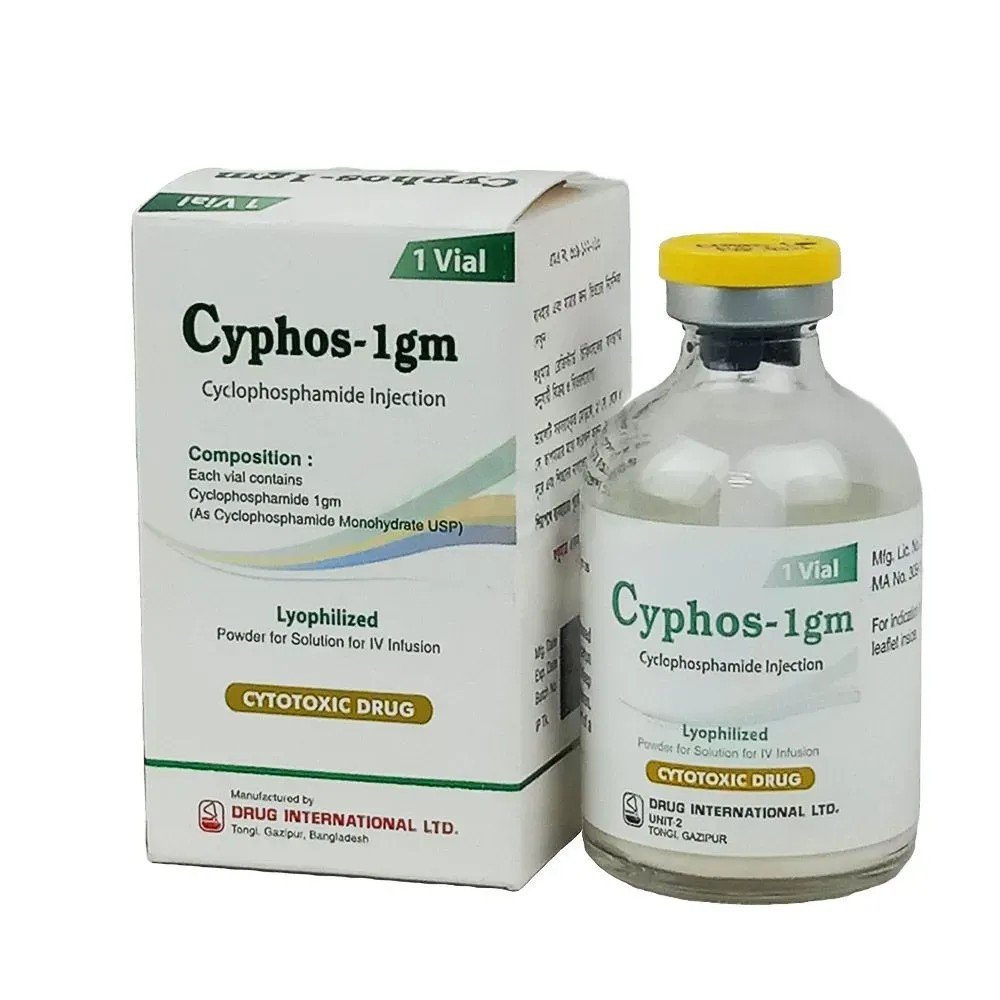
Cyclophosphamide is a prodrug which is converted in the body to the active metabolites. It acts at any stage of the cell cycle but its main action is blockage at the G2 stage. It arrests cell division by alkylating the DNA in a dose-dependent manner. It also exerts immunosuppressive effects possibly due to a cytotoxic effect on lymphocytes.
Precaution
Blood disorders. Elderly or debilitated patients. Diabetic patients. Renal or hepatic impairment or who have gone adrenaloctomy. Previous treatment with x-ray or cytotoxic agents. Monitor haematological profile and presence of RBCs in urine regularly. Maintain adequate hydration and frequent micturition to reduce the risk of cystitis. Lactation: Drug excreted in breast milk; do not nurse
_
Side Effect
Alopecia, skin and nails hyperpigmentation, nausea and vomiting, mucositis, inappropriate antidiuretic hormone secretion, carbohydrate metabolism disturbances, gonadal suppression, interstitial pulmonary fibrosis. Potentially Fatal: Anaphylactic reactions, bone marrow failure, severe immunosuppression, urotoxicity, cardiotoxicity, hyponatraemia, haemorrhagic cystitis.
_
Pregnancy Category Note
Pregnancy Based on mechanism of action and published reports of effects in pregnant patients or animals, drug can cause fetal harm when administered to pregnant woman; exposure to cyclophosphamide during pregnancy may cause fetal malformations, miscarriage, fetal growth retardation, and toxic effects in the newborn; drug is teratogenic and embryo-fetal toxic in mice, rats, rabbits and monkeys; advise pregnant women and females of reproductive potential of the potential risk to the fetus Verify the pregnancy status of females of reproductive potential prior to the initiation of therapy Contraception Therapy can cause fetal harm; advise females of reproductive potential to use effective contraception during treatment for up to 1 year after completion of therapy Based on findings in genetic toxicity and animal reproduction studies, advise male patients with female partners of reproductive potential to use effective contraception during treatment and for 4 months after completion of therapy Infertility Amenorrhea, transient or permanent, associated with decreased estrogen and increased gonadotropin secretion develops in a proportion of women treated with cyclophosphamide Affected patients generally resume regular menses within a few months after cessation of therapy; risk of premature menopause with cyclophosphamide increases with age Oligomenorrhea has also been reported in association with cyclophosphamide treatment Men treated with cyclophosphamide may develop oligospermia or azoospermia, which are normally associated with increased gonadotropin but normal testosterone Lactation Drug is present in breast milk; neutropenia, thrombocytopenia, low hemoglobin, and diarrhea have been reported in infants breast fed by women treated with cyclophosphamide; because of potential for serious adverse reactions in a breastfed child from therapy, advise lactating women not to breastfeed during treatment and for 1 week after last dose
_
Interaction
Increased risk of cardiotoxicity w/ doxorubicin or other cardiotoxic drugs. May increase incidence of mucositis w/ protease inhibitors. May increase haematotoxicity and/or immunosuppression w/ ACE inhibitors, natalizumab, paclitaxel, thiazide diuretics, zidovudine. May increase pulmonary toxicity w/ amiodarone. May increase nephrotoxicity w/ amphotericin B. May result to acute water intoxication w/ indometacin. May increase risk of hepatotoxicity w/ azathioprine. May increase incidence of hepatic veno-occlusive disease and mucositis w/ busulfan. May increase risk of haemorrhagic cystitis w/ previous or concomitant radiotherapy. May result to acute encephalopathy w/ metronidazole. May increase risk of thromboembolic complications. May alter the effect of warfarin. May increase immunosuppressive effect of ciclosporin. May result to prolonged apnoea w/ depolarising muscle relaxants (e.g. suxamethonium).
_






Reviews
Clear filtersThere are no reviews yet.