



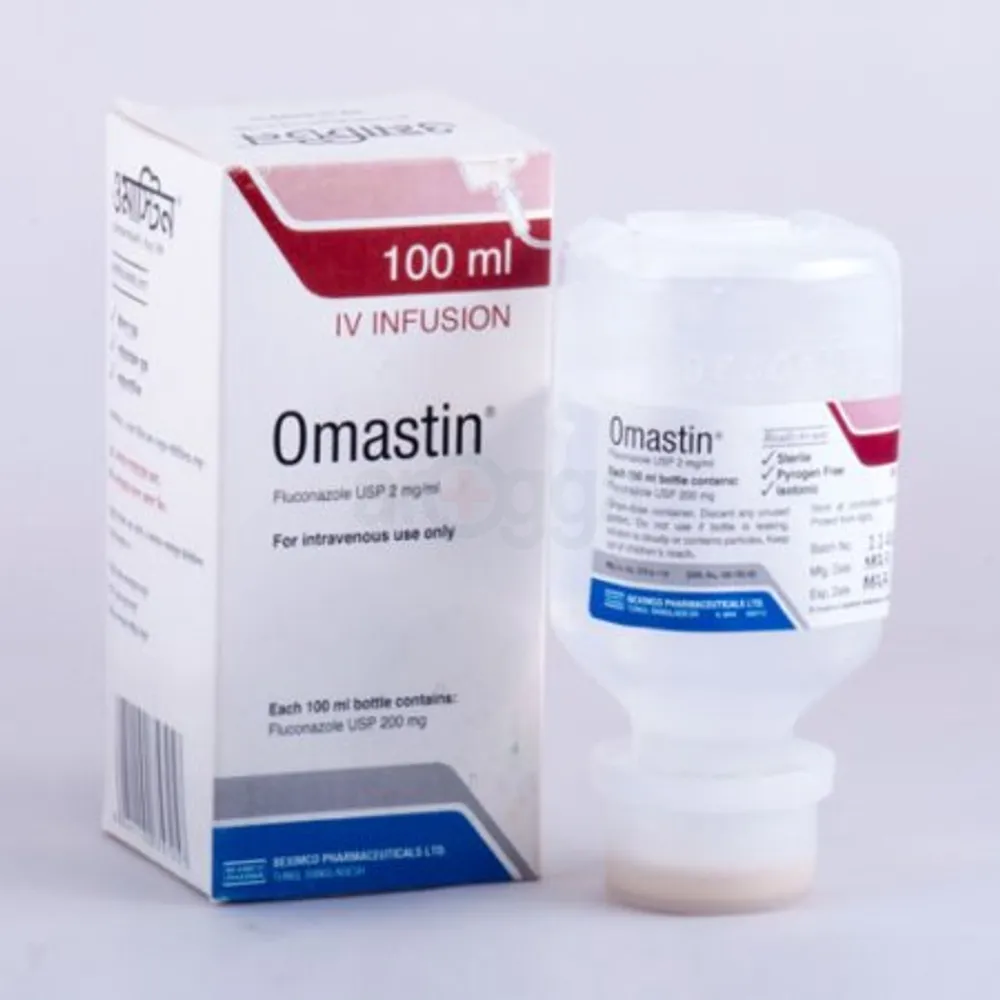

Medicine Overview of Omastin IV 0.20% Infusion
Omastin IV belongs to a group of medicines called antifungals. It works by stopping the growth of fungus and is used to treat infections of the mouth, throat, vagina and other parts of the body including fingernails and toenails. It kills fungi by destroying the fungal cell membrane.
Omastin IV is an injectable drug and given as a drip by a healthcare professional. Do not self administered the injection. Your doctor or nurse will teach you the correct way of injecting it. To get the most benefit, take this medicine at evenly spaced times and continue using it until your prescription is finished, even if your symptoms disappear after a few days. If you stop treatment too early, the infection may return and if you miss doses you can increase your risk of infections that are resistant to further treatment.
The most common side effects of this medicine include stomach pain, headache and feeling sick (nausea). You could ask your doctor about ways of preventing or reducing these effects. You should stop taking it straight away if you have any signs of an allergic reaction or of congestive heart failure. Signs of this include rash, swelling of the lips, throat or face, swallowing or breathing problems, feeling dizzy or faint and nausea.
Do not take it if you are pregnant or could become pregnant unless your doctor has told you to. Talk to your doctor before taking it if you have ever had heart failure, a weak immune system (including HIV/AIDS), kidney problems or liver problems such as yellow skin (jaundice). This medicine may not be suitable for you. If your course of treatment is for more than a month, your doctor may want to check your liver by testing your blood. The medicine may make you dizzy or have blurred vision so do not drive or operate machines until it is safe.
- Fungal infections
- Headache
- Nausea
- Rash
- Vomiting
-
Your doctor has prescribed Omastin IV to cure your infection and improve symptoms.
-
It is given as a drip under the supervision of a medical professional.
-
Do not skip any doses and finish the full course of treatment even if you feel better.
-
Inform your doctor if you notice shortness of breath, swelling in face and throat, and drop-in blood pressure.
-
Use a reliable method of contraception to prevent pregnancy while taking this medicine.
-
Your doctor may check your liver function before starting treatment and regularly thereafter. Inform your doctor if you notice yellowing of eyes or skin, dark urine, or stomach pain.
Intravenous
The daily dose of Fluconazole Injection, for the treatment of infections should be based on the infecting organism and the patient’s response to therapy. Treatment should be continued until clinical parameters or laboratory tests indicate that active fungal infection has subsided. An inadequate period of treatment may lead to recurrence of active infection. Patients with AIDS and cryptococcal meningitis or recurrent oropharyngeal candidiasis usually require maintenance therapy to prevent relapse.
Oropharyngeal candidiasis:
The recommended dosage 200 mg on the first day, followed by 100 mg once daily. Treatment should be continued for at least 2 weeks to decrease the likelihood of relapse.
Esophageal candidiasis:
The recommended dosage is 200 mg on the first day, followed by 100 mg once daily. Doses up to 400 mg/day may be used, based on medical judgment of the patient’s response to therapy. Patients with esophageal candidiasis should be treated for a minimum of three weeks and for at least two weeks following resolution of symptoms.
Systemic candidiasis; Cryptococcal infections
The recommended dosage is 400 mg on the first day, followed by 200 mg once daily. A dosage of 400 mg once daily may be used, based on medical judgment of the patient’s response to therapy.
The recommended duration of treatment for initial therapy of cryptococcal meningitis is 10-12 weeks after the cerebrospinal fluid becomes culture negative.
The recommended dosage of Fluconazole Injection, USP for suppression of relapse of cryptococcal meningitis in patients with AIDS is 200 mg once daily.
Prophylaxis in patients undergoing bone marrow transplantation:
The recommended daily dosage is 400 mg, once daily. Patients who are anticipated to have severe granulocytopenia (less than 500 neutrophils per cu mm) should start Fluconazole Injection, USP prophylaxis several days before the anticipated onset of neutropenia, and continue for 7 days after the neutrophil count rises above 1000 cells per cu mm.
Intravenous
Oropharyngeal candidiasis:
The recommended dosage of Fluconazole Injection, in children is 6 mg/kg on the first day, followed by 3 mg/kg once daily. Treatment should be administered for at least 2 weeks to decrease the likelihood of relapse.
Esophageal candidiasis:
The recommended dosage is 6 mg/kg on the first day, followed by 3 mg/kg once daily. Doses up to 12 mg/kg/day may be used based on medical judgment of the patient’s response to therapy. Patients with esophageal candidiasis should be treated for a minimum of 3 weeks and for at least 2 weeks following the resolution of symptoms.
Systemic Candida infections:
The daily doses of 6-12 mg/kg/day have been used in children.
Cryptococcal meningitis:
The recommended dosage is 12 mg/kg on the first day, followed by 6 mg/kg once daily.
A dosage of 12 mg/kg once daily may be used, based on medical judgment of the patient’s response to therapy. The recommended duration of treatment for initial therapy of cryptococcal meningitis is 10-12 weeks after the cerebrospinal fluid becomes culture negative.
For suppression of relapse of cryptococcal meningitis in children with AIDS, the recommended dose of Fluconazole Injection, USP is 6 mg/kg once daily.
Renal impairment: Haemodialysis patients: Usual dose given after each session.
CrCl (ml/min) Dosage Recommendation
<50 and not receiving dialysis 50% of the usual dose.
>50 Usual dose.
– Known hypersensitivity
– Advanced liver disease
Renal or hepatic impairment. May prolong QT interval. Pregnancy, lactation. CDC guidelines recommend only using topical antifungal products to treat pregnant women with vulvovaginal yeast infections, including for longer periods than usual if these infections persist or recur.
Lactation
Enters breast milk; use caution
>10%
Headache (2-13%)
1-10%
Nausea (2-7%),Abdominal pain (2-6%),Diarrhea (2-3%),Rash (2%),Vomiting (2-5%)
Frequency Not Defined
QT prolongation,Torsades de pointes,Alopecia,Anaphylactic reactions,Angioedema,Cholestasis,Dizziness,Dyspnea,Hepatic failure,Hepatitis,Hypertriglyceridemia,Hypokalemia,Increased alkaline phosphatase,Increased ALT/AST,Jaundice,Leukopenia,Pallor,Seizures,Stevens-Johnson syndrome,Taste perversion,Thrombocytopenia,Toxic epidermal necrolysis
Potentially Fatal: Hepatotoxicity; rarely anaphylaxis; Stevens-Johnson syndrome.
Pregnancy
Single maternal PO dose of 150 mg for vaginal candidiasis
Results of a Danish study concludes there is a possible increased risk of miscarriage; women who are pregnant or actively trying to get pregnant should ask their physician about alternative treatments
Spontaneous abortion between 7 and 22 weeks’ gestation occurred significantly more often in women exposed to oral fluconazole than unexposed pregnancies (4.43% vs. 4.25%; hazard ratio, 1.48); fluconazole was also compared with intravaginal azole antifungals to account for confounding by candidiasis, again, the oral drug was associated with significantly increased risk for spontaneous abortion – JAMA. 2016;315(1):58-67
CDC guidelines recommend only using topical antifungal products to treat pregnant women with vulvovaginal yeast infections, including for longer periods than usual if these infections persist or recur
All other indications
Use in pregnancy should be avoided except in patients with severe or potentially life-threatening fungal infections in whom fluconazole may be used if the anticipated benefit outweighs the possible risk to the fetus
A few published case reports describe a rare pattern of distinct congenital anomalies in infants exposed in-utero to high dose maternal fluconazole (400-800 mg/day) during most or all of the first trimester
Effective contraceptive measures should be considered in women of child-bearing potential who are being treated with 400-800 mg/day and should continue throughout the treatment period and for approximately 1 week (5 to 6 half-lives) after the final dose
Reported anomalies are similar to those seen in animal studies and consist of brachycephaly, abnormal facies, abnormal calvarial development, cleft palate, femoral bowing, thin ribs and long bones, arthrogryposis, and congenital heart disease
Lactation
Secreted in human milk at concentrations similar to maternal plasma concentrations; use caution (AAP Committee states “compatible with nursing”)
May increase plasma concentrations of oral hypoglycaemics (e.g. tolbutamide, glyburide, glipizide), phenytoin, theophylline, tofacitinib, rifabutin. May increase prothrombin time w/ anticoagulants. May cause significant increase in ciclosporin levels in renal transplant patients w/ or w/o renal impairment. Rifampicin reduces fluconazole levels. May increase risk of nephrotoxicity w/ tacrolimus. May increase the effect of short-acting benzodiazepines (e.g. midazolam).
Potentially Fatal: Increased risk of cardiac arrhythmias or QT prolongation w/ terfenadine, cisapride, astemizole, pimozide, quinidine, halofantrine and erythromycin.



Reviews
Clear filtersThere are no reviews yet.