


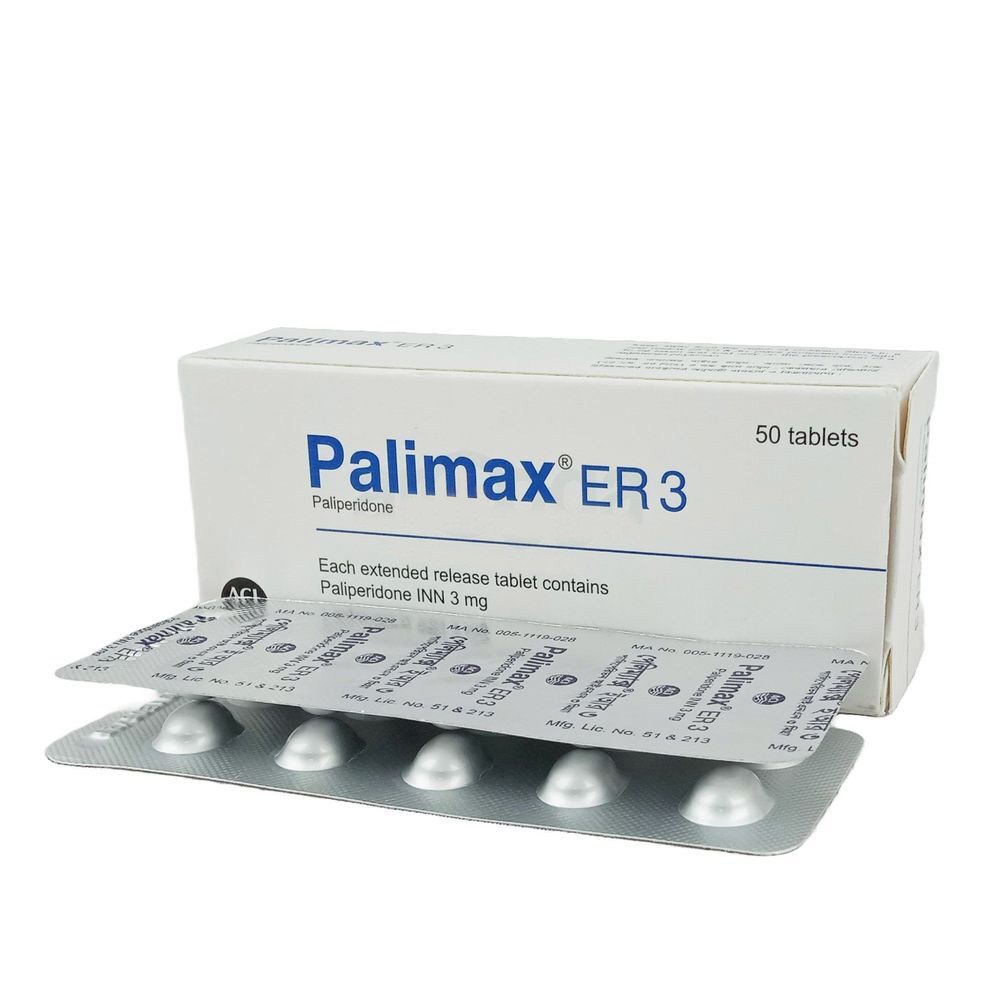

Medicine Overview of Palimax ER 3mg Tablet
Palimax ER 3 is a prescription medicine used in the treatment of schizophrenia (a mental disorder that can result in hallucinations or delusions and also adversely affects a person’s ability to think and behave) and mania.
Palimax ER 3 may be taken with or without food. However, it is advised to take it at the same time each day as this helps to maintain a consistent level of medicine in the body. Take this in the dose and duration as advised by your doctor and if you have missed a dose, take it as soon as you remember. It is important that this medication is not stopped suddenly without talking to your doctor as it may worsen your symptoms. However, discontinue this medicine immediately if you experience Neuroleptic malignant syndrome (NMS), characterized by fever, muscle rigidity, and altered consciousness.
Some common side effects of this medicine includes nystagmus (involuntary eye movement) and tremor. It also causes dizziness and sleepiness, so do not drive or do anything that requires mental focus until you know how this medicine affects you.
You should be cautious if you are using this medicine as it may increase the risk of developing diabetes, so it is better to monitor glucose regularly. Inform your doctor if you develop any unusual changes in mood or behavior, new or worsening depression, or suicidal thoughts while taking this medicine.
Show less
- Schizophrenia
- Mania
- Abnormal involuntary movements
- Dizziness
- Nystagmus (involuntary eye movement)
- Sleepiness
- Tremor
-
Take it in the morning, preferably at the same time every day.
-
To lower the chance of feeling dizzy or passing out, rise slowly if you have been sitting or lying down.
-
Use caution while driving or doing anything that requires concentration as Palimax ER 3 can cause dizziness and sleepiness.
-
It may cause an increase in weight, blood sugar, cholesterol, and triglycerides (fat). Eat healthy, exercise, and monitor your levels regularly.
-
Monitor your blood sugar regularly as Palimax ER 3 can affect blood sugar levels.
-
Do not stop taking Palimax ER 3 without talking to your doctor first as it may cause a worsening of symptoms.
Oral
Schizophrenia
Adult: Initially, 6 mg once daily in the morning.
May be titrated upward or downward in increments of 3 mg/day at intervals >5 days; not to exceed 12 mg/day
Schizoaffective Disorder
Indicated for schizoaffective disorder as monotherapy and as an adjunct to mood stabilizers or antidepressants
6 mg PO qDay in am (range 3-12 mg); titration may not be necessary; if exceeding 6 mg/day, increases of 3 mg/day recommended at intervals of 4 days of more; not to exceed 12 mg/day
Show less
Schizophrenia
<12 years: Safety and efficacy not established
>12 years (<51 kg): 3 mg/day PO initially; may be increased if necessary in increments of 3 mg/day at intervals ?5 days; not to exceed 6 mg/day
>12 years (>51 kg): 3 mg/day PO initially; may be increased if necessary in increments of 3 mg/day at intervals ?5 days; not to exceed 12 mg/day
Schizoaffective Disorder
<18 years: Safety and efficacy not established
Show less
Renal impairment
CrCl 50-79 mL/min: 3 mg/day initially; not to exceed 6 mg/day
CrCl 10-49 mL/min: 1.5 mg/day initially; not to exceed 3 mg/day
CrCl <10 mL/min: Not recommended
Show less
Major metabolite of risperidone; improves negative symptoms of psychoses and reduces incidence of EPS
Has high affinity for serotonin type 2 (5-HT2) receptors; binds to dopamine D2 receptors with 20 times lower affinity than that for 5-HT2 receptors; antagonizes alpha1-adrenergic, alpha2-adrenergic, and histaminergic receptors; has moderate affinity for serotonin type 1 (5-HT1C, 5-HT1D, 5-HT1A) receptors; has weak affinity for dopamine D1 receptors; has no affinity for muscarinic, beta1-adrenergic, and beta2-adrenergic receptors
Show less
Patient w/ known CV disease or family history of QT prolongation, history of seizures or other conditions that potentially lower the seizure threshold, predisposition to GI obstruction, possible prolactin-dependent tumours, Parkinson’s disease. Cataract surgery. Elderly w/ dementia-related psychosis and risk factors for stroke. Renal impairment. Pregnancy and lactation. Patient Counselling This drug may cause somnolence and impairment of judgment, thinking or motor skills, if affected, avoid driving, operating machinery or performing hazardous tasks. Monitoring Parameters Monitor mental status changes, vital signs, wt, BP, electrolyte, renal and hepatic function. Closely monitor for worsening glucose control in patients w/ pre-existing DM.
Lactation: Drug excreted in breast milk; do not nurse
Show less
>10%
Akathisia,Somnolence,Insomnia,Parkinsonism,Tachycardia,Hyperprolactinemia,Others similar to placebo (eg, headache)
<10% (selected)
Cough,Dystonia,Extrapyramidal symptoms (EPS),Orthostatic hypotension,QT prolongation,Sialorrhea,Priapism,Weight gain,Constipation,Indigestion,Amenorrhea,Galactorrhea,Nausea,Dyspepsia,Salivation,Xerostomia,Myalgia,Extremity pain,Nasopharyngitis
Show less




Reviews
Clear filtersThere are no reviews yet.