



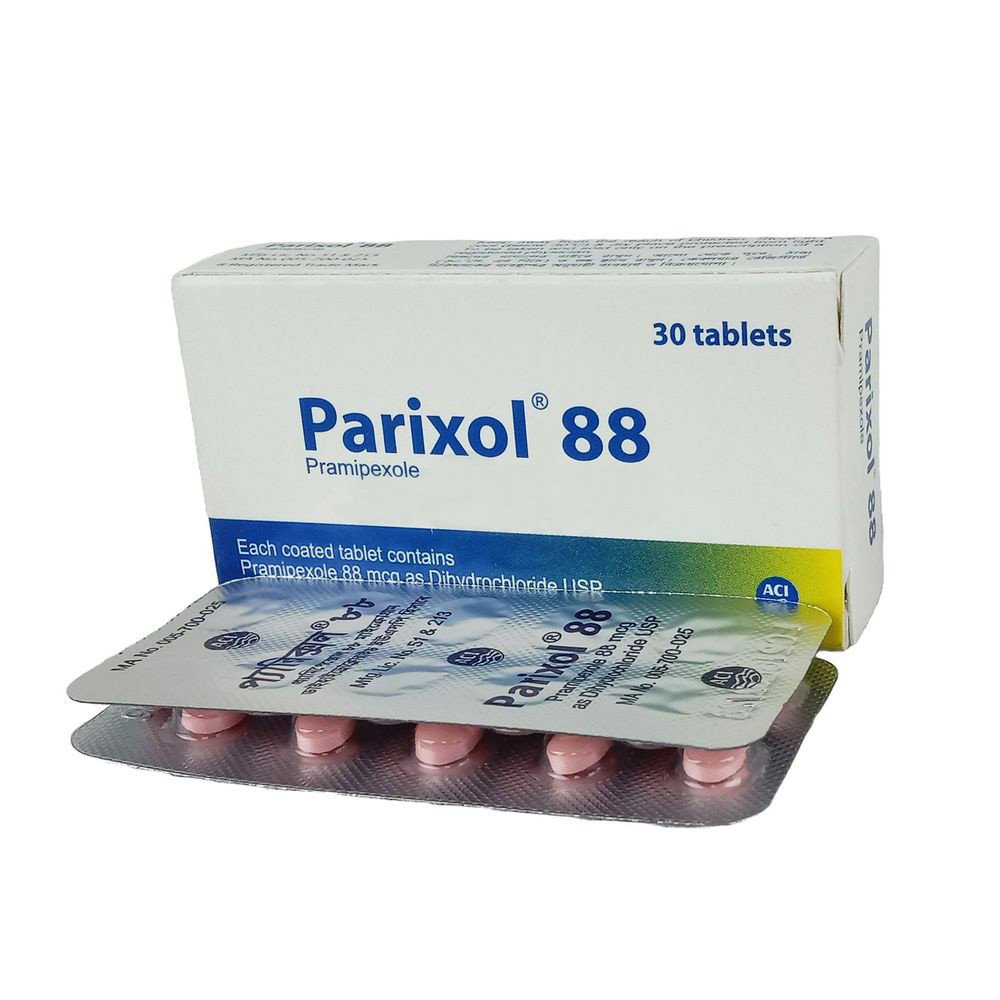

Medicine Overview of Parixol 88 88mcg Tablet
Parixol 88 is a prescription medicine used in the treatment of Parkinson’s disease and restless leg syndrome (an urge to move the legs usually accompanied or caused by uncomfortable and unpleasant leg sensations). It helps to treat excessive shaking by slowing down the body movements.
Parixol 88 should be taken with food. However, take it at the same time each day as this helps to maintain a consistent level of medicine in the body. Take this medicine in the dose and duration as advised by your doctor and if you have missed a dose, take it as soon as you remember it. You should never skip any doses and finish the full course of treatment even if you feel better. It is important that this medication is not stopped suddenly without talking to your doctor.
Some common side effects of this medicine include nausea, dry mouth, fatigue, hallucinations, constipation, and peripheral edema. It also causes dizziness and sleepiness, so do not drive or do anything that requires mental focus until you know how this medicine affects you. Inform your doctor if you develop any unusual changes in mood, an abnormally high sex drive, an urge to gamble or uncontrolled spending as these may prove very harmful.
Show less
- Parkinson's disease
- Restless leg syndrome
- Dizziness
- Sleepiness
- Nausea
- Dryness in mouth
- Fatigue
- Hallucination
- Constipation
- Peripheral edema
-
You have been prescribed Parixol 88 to treat your symptoms of Parkinson’s disease and/or restless leg syndrome.
-
It can be taken with or without food. Taking it with food may reduce nausea.
-
For restless leg syndrome, take this medicine 2 to 3 hours before bedtime.
-
Avoid activities that require you to be alert, such as driving a car until you know how this medication affects you.
-
When you first start taking Parixol 88, it may cause sudden drop in your blood pressure when you change positions. To lower the chance of feeling dizzy or passing out, rise slowly if you have been sitting or lying down.
-
Talk to your doctor in case you develop hallucinations or other changes in your behavior.
-
Inform your doctor if you develop compulsive behaviors that are hard to control, such as binge eating, gambling, spending money, and sexual urges.
-
Do not stop taking the medication suddenly without talking to your doctor.
Parkinson Disease
Immediate-release: 0.125 mg PO q8hr initially; gradually titrated upward at weekly intervals to target range of 1.5-4.5 mg/day PO divided q8hr
Restless Legs Syndrome
0.125 mg/day PO 2-3 hr before bedtime initially; may be increased every 4-7 days up to 0.5 mg/day (every 14 days if CrCl 20-60 mL/min)
Show less
Parkinson disease
Immediate release
CrCl >50 mL/min: Dosage adjustment not necessary
CrCl 30-50 mL/min: 0.125 mg twice daily initially; not to exceed 0.75 mg TID
CrCl 15-29 mL/min: 0.125 mg qDay; not to exceed 1.5 mg qDay
CrCl <15 mL/min: Dosage adjustment not provided in manufacturer’s labeling; not studied
ESRD requiring hemodialysis: Dosage adjustment not provided in manufacturer’s labeling; not studied
Restless legs syndrome
Immediate release
CrCl >60 mL/min: Dosasge adjustment not necessary
CrCl 20-60 mL/min: Dosage adjustment not necessary but duration between titration should be increased to 14 days
CrCl<20 mL/min: Dosage adjustment not provided by manufacturer’s labeling; not studied
Show less
>10%
Somnolence,Dyskinesia,Hallucinations,Insomnia,Dizziness,Postural hypotension,Nausea,Constipation
1-10% (partial list)
Abnormal dreams, thoughts, or vision,Amnesia,Confusion,Paranoia or delusion,Akathisia,Asthenia,Dry mouth
Show less
Inhibits active tubular secretion of basic cationic drugs eg, cimetidine. Reduced clearance w/ drugs eliminated by active renal tubular secretion eg, amantadine. Alcohol & other sedatives.
Show less





Reviews
Clear filtersThere are no reviews yet.