


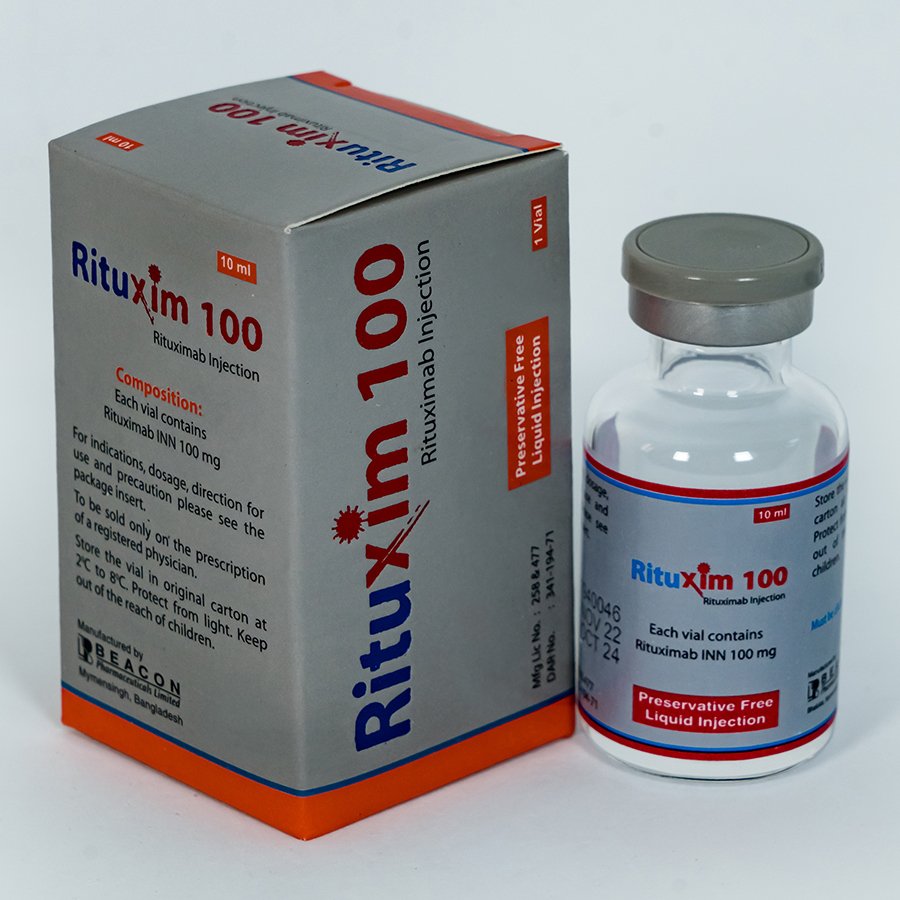

Medicine Overview of Rituxim 100mg/10ml Injection
Rituxim is used in the treatment of non-Hodgkin lymphoma (NHL), rheumatoid arthritis, blood cancer (chronic lymphocytic leukemia), granulomatosis with polyangiitis and microscopic polyangiitis.
Rituxim is given as an injection under the supervision of doctor. You must take it in a dose as advised by the doctor. Your doctor will decide what dose is necessary and how often you need to take it. This will depend on what you are being treated for and may change from time to time. You should take it exactly as your doctor has advised. Taking it in the wrong way or taking too much can cause very serious side effects. It may take several weeks or months for you to see or feel the benefits but do not stop taking it unless your doctor tells you to.
The most common side effects of this medicine include headache, weakness, edema, infection, and hair loss. This medicine may reduce the number of blood cells (decrease red blood and white blood cells) in your blood, thereby, increasing the susceptibility to infections. Regular blood tests are required to check your blood cells along with hepatitis B.
Before taking it, tell your doctor if you have heart disease, liver, or planning surgery or vaccination or are taking any medicines to treat infections. Many other medicines can affect, or be affected by, this medicine so let your doctor know all medications you are using. This medicine is not recommended during pregnancy or while breastfeeding. The use of effective contraception by both males and females during treatment is important to avoid pregnancy.
- Non-Hodgkin lymphoma (NHL)
- Rheumatoid arthritis
- Blood cancer (Chronic lymphocytic leukemia)
- Granulomatosis with polyangiitis
- Microscopic polyangiitis
- Headache
- Weakness
- Edema (swelling)
- Infection
- Hair loss
- Itching
- Chills
- Febrile neutropenia
- Decreased white blood cell count (neutrophils)
- Infusion reaction
- Increased risk of infection
- Decreased blood cells (red cells, white cells, and platelets)
-
It is given as a drip (intravenous infusion) by your doctor or nurse.
-
You may be given some painkillers, antihistamine and possibly steroids before the drip to help prevent infusion reaction.
-
Your doctor may get blood tests done to check for hepatitis B before treatment and to monitor your blood cells during treatment with this medicine.
-
Inform your doctor immediately if you notice any signs of infection such as fever, sore throat or rash.
-
Inform your doctor if you are pregnant, planning to conceive or breastfeeding.
-
Inform your doctor if you have any heart rhythm problems, if you are having surgery or if you plan to get any vaccinations.
Reconstitution: Dilute the appropriate dose w/ sodium chloride 0.9% or glucose 5% to a final concentration of between 1 and 4 mg/mL.
IV Administration
Consider premedication (ie, paracetamol and diphenhydramine, or glucocorticoids for RA) before each infusion
Administer by slow IV infusion only; do not administer as an IV
First IV infusion rate: Start 50 mg/hr; increase by 50 mg/hr q30min, not to exceed 400 mg/hr
Subsequent IV infusions (90 minutes)
Standard IV infusions: Start 100 mg/hr, increase by 100 mg/hr q30min, not to exceed 400 mg/hr; institutional protocols may allow faster increments
Intravenous
Non-Hodgkin Lymphoma
Recommended dose for NHL
375 mg/m² IV infusion according to the following schedules
Relapsed or refractory low-grade or follicular, CD20-positive, B-cell NHL: Once weekly x4-8 doses
Retreatment for relapsed or refractory, low-grade or follicular, CD20-positive, B-cell NHL: Once weekly x4 doses
Previously untreated, follicular, CD20-positive, B-cell NHL: Administer on Day 1 of each chemotherapy cycle for up to 8 doses; with complete or partial response, initiate maintenance 8 weeks following completion of combination chemotherapy as a single-agent q8weeks for 12 doses
Nonprogressing, low-grade, CD20-positive, B-cell NHL, after first-line CVP chemotherapy: Following completion of 6-8 cycles of CVP chemotherapy, administer once weekly for 4 doses at 6-month intervals to a maximum of 16 doses
Diffuse large B-cell NHL: Administer on Day 1 of each cycle of chemotherapy for up to 8 infusions
Chronic Lymphocytic Leukemia
Indicated for untreated and previously treated CD20-positive CLL; combined therapy with fludarabine and cyclophosphamide (FC)
375 mg/m² IV infusion on day 1 of 1st cycle (for 1st cycle, administer 1 day before chemotherapy with FC), THEN
500 mg/m² IV on day 1 of subsequent cycles (administer on same day as chemotherapy with FC)
Repeat q28 days x6 cycles
Fludarabine & cyclophosphamide dosage
Fludarabine: 25 mg/m² IV qDay x 3 days
Cyclophosphamide: 250 mg/m² IV qDay x3 days
Repeat q28 days x 6 cycles
Rheumatoid Arthritis
1000 mg IV infusion, repeat after 2 week (2 infusions separated by 2 week is 1 course)
Repeat course q24weeks or based on clinical evaluation (but no sooner than 16 weeks)
Used in combo with methotrexate
Premedicate with glucocorticoids 30 minutes before infusion to reduce infusion rxn
Not to exceed 1000 mg/dose
Extensive tumor burden, pulmonary tumor infiltration or pulmonary insufficiency; history of cardiac disease; effective contraception during and up to 12 mth after treatment; pregnancy. Monitor CBC and platelet counts regularly. Premedication with analgesics, antihistamines and corticosteroids may be recommended. Monitor for signs of active infection or hepatitis in hepatitis B carriers. Discontinue treatment if viral hepatitis develops.
Lactation: not known if excreted in breast milk, do not nurse
>10%
NHL
Angioedema (11%), hypotension (10%), Asthenia (26%), chills (33%), dizziness (10%), fever (53%), headache (19%)
Pruritus (14%), rash (15%), Abdominal pain (14%), diarrhea (10%), nausea (23%), vomiting (10%)
Leukopenia (14%), lymphopenia (48%), neutropenia (14%), thrombocytopenia (12%), Back pain (10%), myalgia (10%)
Cough (13%), rhinitis (12%), Infection (31%), night sweats (15%)
1-10%
NHL
Edema,Flushing,Hypertension,Anxiety,Anemia,Elevated LDH,Hyperglycemia,Bronchospasm, dyspnea, sinusitis, throat irritation, urticaria,RA (Rituximab+Methotrexate vs Methotrexate Alone)
Hypertension,Anxiety, asthenia, chills, migraine, paresthesia, pyrexia,Pruritus, urticaria,Dyspepsia, nausea, upper abd pain,Hypercholesterolemia,Arthralgia,Rhinitis, throat irritation, URI
Frequency Not Defined
Tumor lysis syndrome,Lymphoid malignancies,Hypogammaglobulinemia
Potentially Fatal: Pulmonary or cardiac toxicity during infusion; severe mucocutaneous reactions; severe cytokine release syndrome associated with tumor lysis syndrome. Toxic epidermal necrolysis.
Increased risk of renal toxicity w/ cisplatin.
Potentially Fatal: May decrease the efficacy of vaccines and increase the risk of infections in patients immunised w/ live vaccines.


Reviews
Clear filtersThere are no reviews yet.