

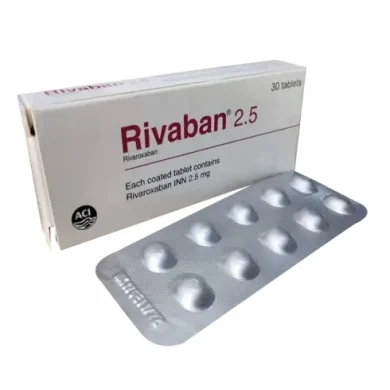
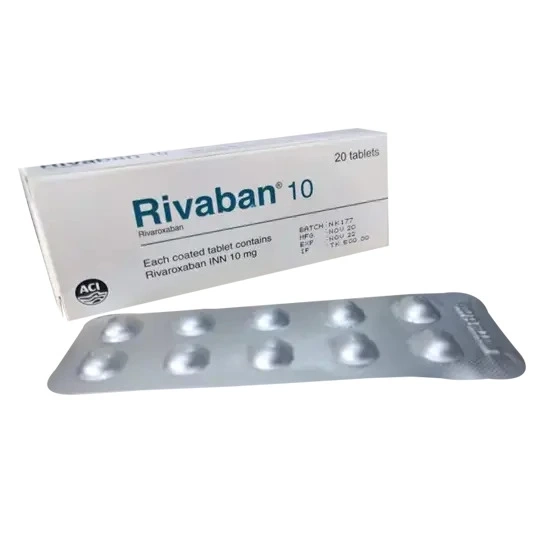

Medicine Overview of Rivaban 10mg Tablet
Rivaban 10 is a medicine known as an anticoagulant or blood thinner. It helps prevent and treat blood clots. It is used to reduce the risk of stroke and heart attack. It prevents and treats clot formation in the veins of your legs, lungs, brain and heart.
Rivaban 10 is commonly used in patients with irregular heart rhythm (atrial fibrillation) to prevent clot formation. It also reduces the risk of getting clots in people who have undergone knee or hip replacement surgeries. It should be taken with food and it is best to take them at the same time each day. You may need to take this medicine for many years, even for life in some cases. Do not stop taking it or change the dose without guidance from your doctor. It could quickly put you more at risk of having a heart attack, stroke or thrombosis (formation of a blood clot within a blood vessel). You can reduce your risk of having a blood clot by making changes to your lifestyle, such as not smoking, eating a healthy diet, getting regular exercise and losing weight if you need to.
The most common side effect of Rivaban 10 is bleeding more easily than normal, for example, having nosebleeds or bruising. If you experience any symptoms, tell your doctor immediately. Other side effects include low blood pressure, skin rash, stomach ache, indigestion, and fever.
Do not take this medicine if you have severe kidney or liver problems, if you are currently bleeding or if you are taking other medicines to reduce blood clotting. You should not breastfeed while using this medicine. Unlike other anticoagulants, a regular blood test (PT-INR) is not required while taking this medicine.
Show less
- Deep vein thrombosis
- Pulmonary embolism
- Stroke prevention
- Anemia (low number of red blood cells)
- Nausea
-
For best results, take Rivaban 10 at the same time every day. It is better to take at night with meals.
-
It interacts less with food or other medicines. Hence, frequent dose changes are not required.
-
It increases your risk of bleeding. Be careful while shaving, cutting fingernails or toenails, using sharp objects or engaging in contact sports (e.g. football, wrestling).
-
It may cause dizziness. Avoid driving or activity requiring mental focus until you know how it affects you.
-
If you are going to have a surgery or dental treatment, you may be asked to stop taking Rivaban 10 temporarily.
-
Notify your doctor if you have any kidney problem.
-
Inform your doctor if you are pregnant, planning pregnancy or breastfeeding.
-
Do not stop taking medication without talking to your doctor.
10-Mg Tab: May be taken with or without food.
15- & 20-Mg Tab: Should be taken with food.
Show less
DVT Prophylaxis (Orthopedic Surgery)
Indicated for prophylaxis of deep vein thrombosis (DVT), which may lead to pulmonary embolism (PE) in patients undergoing knee or hip replacement surgery
Knee replacement: 10 mg PO qDay for 12 days; may take with or without food
Hip replacement: 10 mg PO qDay for 35 days; may take with or without food
Administer initial dose at least 6-10 hr after surgery once hemostasis has been established
Nonvalvular Atrial Fibrillation
Indicated to reduce the risk of stroke and systemic embolism in patients with nonvalvular atrial fibrillation
20 mg/day PO with the evening meal
DVT or PE Treatment
Indicated for treatment of DVT and PE
15 mg PO q12hr for 21 days with food, THEN 20 mg PO qDay for 6 months
Reduce risk for recurrent DVT or PE
Indicated to reduce the risk of recurrence of DVT and PE following initial 6 months treatment for DVT and/or PE
20 mg PO qDay following initial 6 months of treatment for DVT and/or PE
Hepatic impairment
Moderate impairment: Not studied
Avoid use in patients with moderate-to-severe impairment (Child-Pugh B) or severe (Child-Pugh C) hepatic impairment or with any hepatic disease associated with coagulopathy
Show less
Renal impairment (nonvalvular AF)
CrCl 30-50 mL/min: 20 mg/day
CrCl 15-50 mL/min: 15 mg/day
ESRD on intermittent renal dialysis: 15 mg/day
Renal impairment (postoperative thromboprophylaxis)
CrCl >50 mL/min: Dose adjustment not necessary
CrCl 30-50 mL/min: Use with caution; dose adjustment not necessary
CrCl <30 mL/min: Avoid use
Show less
Factor Xa inhibitor that inhibits platelet activation by selectively blocking the active site of factor Xa without requiring a cofactor (eg, antithrombin III) for activity.
Blood coagulation cascade is dependent on the activation of factor X to factor Xa via the intrinsic and extrinsic pathways plays a central role in the blood coagulation cascade.
Dose-dependent inhibition of factor Xa activity observed; antifactor Xa activity is also influenced by rivaroxaban; prolongs PT and aPTT and HepTest .
Show less
Patient w/ hepatic disease associated w/ coagulopathy, severe HTN, prosthetic heart valve, vascular retinopathy, bronchiectasis. Anaesth w/ post-op indwelling epidural catheter. Hepatic and renal impairment. Pregnancy and lactation.
Lactation: Unknown whether distributed in human breast milk; not recommended; a decision should be made whether to discontinue nursing or discontinue the drug, taking into account the importance of the drug to the mother
Show less
1-10%
Abdominal pain (<2%),Back pain (<4%),Blister (1%),Bruising (3%),Constipation (<3%),Diarrhea (<5%),Dizziness (<6%),Dyspepsia (<2%),Epistaxis (4-10%),Fatigue (<3%),Headache (3-5%),Nausea (1-3%),Hematuria (<4%),Muscle spasm (1%),Oropharyngeal pain (<1%),Osteoarthritis (<2%),Peripheral edema (<6%),Pruritus (<2%),Pyrexia (1-3%),Rash (2%),Syncope (<2%),Toothache (<1%),Urinary tract infection (<1%),Vomiting (<2%),Wound secretion (<3%)
Bleeding
Atrial fibrillation (21%; major bleeding 6%)
DVT prophylaxis (5-6%; major bleeding <1%)
DVT treatment (6-10%; major bleeding 1%)
Hematoma (<3%)
<1%
Agranulocytosis,Hepatitis,Dysuria,Fatal bleeding,Hematoma,Hemiparesis,Hemorrhage,Hypotension,Increased amylase,Increased BUN,Jaundice,Menorrhagia,Retroperitoneal bleeding,Stevens-Johnson syndrome,Thrombocytopenia,Urticaria,Xerostomia
Show less
Reduced hepatic & renal clearance w/ strong CYP3A4 inhibitors (clarithromycin, erythromycin, fluconazole). Increased bleeding risk w/ azole antimycotics (eg ketoconazole, itraconazole, voriconazole, posaconazole) or HIV-PIs (eg ritonavir); other anticoagulants; NSAIDs (including acetylsalicylic acid) & platelet aggregation inhibitors. Reduced plasma conc w/ CYP3A4 inducers (eg rifampicin, phenytoin, carbamazepine, phenobarb, St. John’s wort). 20-mg FC tab: Increased prothrombin time/INR of warfarin.
Show less





Reviews
Clear filtersThere are no reviews yet.