



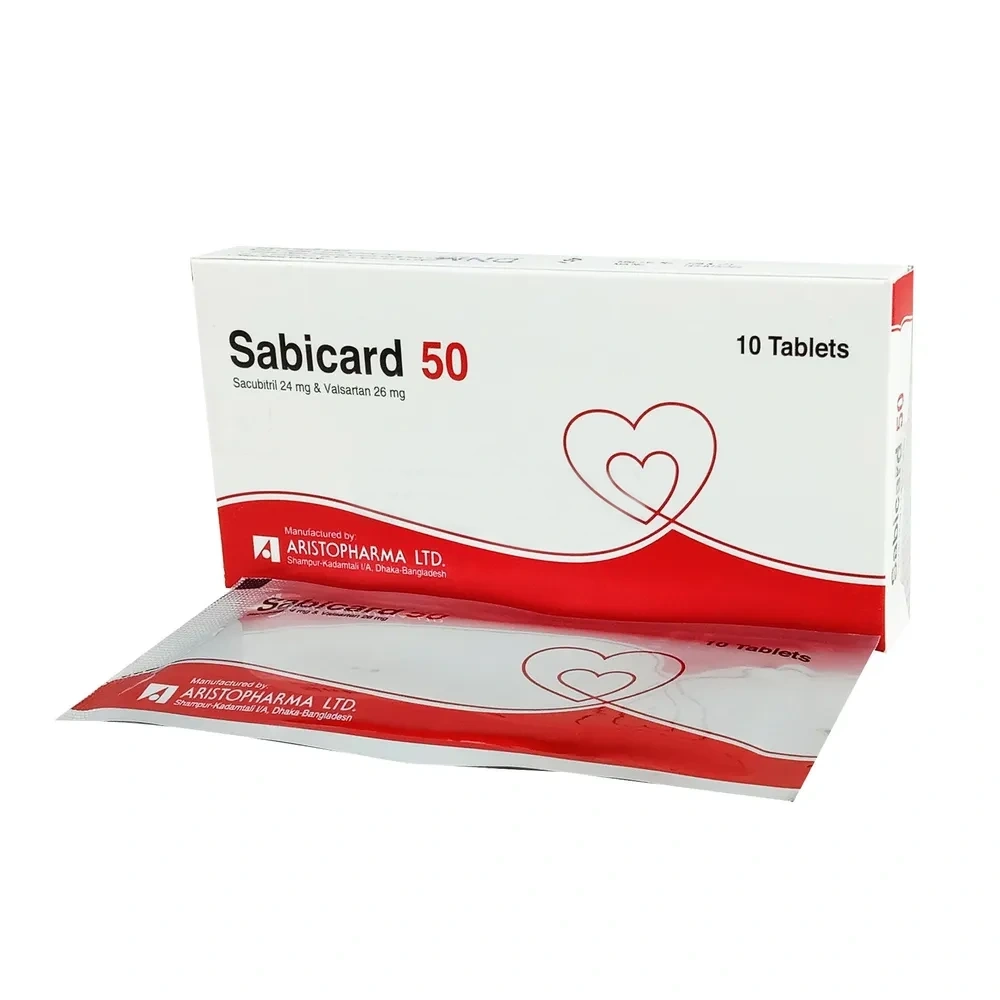

Medicine Overview of Sabicard 50 24mg+26mg Tablet
Introduction
Sabicard 50 is a combination medicine used to treat heart failure. It reduces the risk of hospitalization and death due to long-lasting (chronic) heart failure. Sabicard 50 can be taken with or without food but is best taken at the same time(s) each day. Swallow it as a whole with water. Your dose, and how often you take it, will be decided by your doctor and may change depending on how well you respond to the medicine. Keep taking the tablets regularly, as they have been prescribed, and try not to miss doses to get the most benefit. Do not
Uses of Sabicard 50
- Heart failure
Side effects of Sabicard 50
Common
- Cough
- Dizziness
- Orthostatic hypotension (sudden lowering of blood pressure on standing)
- Altered levels of potassium in blood
- Decreased red blood cell count
- Decreased blood pressure
- Hypoglycemia (low blood glucose level)
- Diarrhea
- Fainting
- Headache
- Nausea
- Stomach pain
- Vertigo
- Weakness
How to use Sabicard 50
Take this medicine in the dose and duration as advised by your doctor. Swallow it as a whole. Do not chew, crush or break it. Sabicard 50 may be taken with or without food, but it is better to take it at a fixed time.
How Sabicard 50 works
Sabicard 50 is a combination of two medicines: Sacubitril and Valsartan which belong to a class of angiotensin receptor neprilysin inhibitor (ARNI). This combination treats heart failure by relaxing the blood vessels and making it easier for your heart to pump blood throughout your body. In addition, it also helps your body retain less water.
Quick Tips
-
You have been prescribed Sabicard 50 for the treatment of of long-lasting (chronic) heart failure.
-
You should continue to stay active (light walking, stretching) and eat a healthy, low sodium diet along with taking this medication.
-
To reduce the chances of feeling dizzy, rise slowly if you have been sitting or lying down.
-
It may cause the level of potassium in your blood to go up. Avoid taking potassium supplements and potassium-rich foods such as banana and broccoli.
-
Inform your doctor if you have a history of liver or kidney diseases.
-
Do not take Sabicard 50 if you are pregnant or breastfeeding.
Brief Description
Indication
Heart Failure,
Administration
May take with or without food
Adult Dose
Heart Failure Indicated to reduce the risk of cardiovascular death and hospitalization for heart failure (HF) in patients with chronic heart failure (CHF) (NYHA class II-IV) and reduced ejection fraction Recommended starting dose: 49 mg/51 mg PO BID Target maintenance dose: After 2-4 weeks, double the dose to the target maintenance dose of 97 mg/103 mg PO BID as tolerated Hepatic impairment Mild (Child-Pugh A): No starting dose adjustment required Moderate (Child-Pugh B): Reduce starting dose to 24 mg/26 mg BID; double the dose every 2-4 weeks to target maintenance dose of 97 mg/103 mg BID as tolerated Severe (Child-Pugh
Renal Dose
Renal impairment
Mild-to-moderate (eGFR ?30 mL/min/1.73 m²): No starting dose adjustment required
Severe (eGFR <30 mL/min/1.73 m²): Reduce starting dose to 24 mg/26 mg BID; double the dose every 2-4 weeks to target maintenance dose of 97 mg/103 mg BID as tolerated
Mild-to-moderate (eGFR ?30 mL/min/1.73 m²): No starting dose adjustment required
Severe (eGFR <30 mL/min/1.73 m²): Reduce starting dose to 24 mg/26 mg BID; double the dose every 2-4 weeks to target maintenance dose of 97 mg/103 mg BID as tolerated
Contraindication
Hypersensitivity to any component
History of angioedema related to previous ACE inhibitor or ARB therapy
Coadministration of neprilysin inhibitors (eg, sacubitril) with ACE inhibitors may increase angioedema risk; do not administer ACE inhibitors within 36 hr of switching to or from sacubitril/valsartan
Concomitant use with aliskiren in patients with diabetes
History of angioedema related to previous ACE inhibitor or ARB therapy
Coadministration of neprilysin inhibitors (eg, sacubitril) with ACE inhibitors may increase angioedema risk; do not administer ACE inhibitors within 36 hr of switching to or from sacubitril/valsartan
Concomitant use with aliskiren in patients with diabetes
Mode of Action
Combination is an angiotensin receptor-neprilysin inhibitor (ARNi)
Sacubitril: Neprilysin inhibitor; neprilysin is responsible for degradation of atrial and brain natriuretic peptide; the cardiovascular and renal effects of sacubitril’s active metabolite (LBQ657) in heart failure are attributed to the increased levels of peptides that are degraded by neprilysin (eg, natriuretic peptide); administration results in increased natriuresis, increased urine cGMP, and decreased plasma MR-proANP and NT-proBNP
Valsartan: Angiotensin II receptor type I inhibitor; decreases blood pressure and blocks vasoconstrictor and aldosterone-secreting effects of angiotensin II
Sacubitril: Neprilysin inhibitor; neprilysin is responsible for degradation of atrial and brain natriuretic peptide; the cardiovascular and renal effects of sacubitril’s active metabolite (LBQ657) in heart failure are attributed to the increased levels of peptides that are degraded by neprilysin (eg, natriuretic peptide); administration results in increased natriuresis, increased urine cGMP, and decreased plasma MR-proANP and NT-proBNP
Valsartan: Angiotensin II receptor type I inhibitor; decreases blood pressure and blocks vasoconstrictor and aldosterone-secreting effects of angiotensin II
Precaution
Can cause fetal harm when administered to a pregnant woman; use of drugs that act on the renin-angiotensin system during the second and third trimesters of pregnancy reduces fetal renal function and increases fetal and neonatal morbidity and death (see Black Box Warnings) Observe for signs and symptoms of angioedema; if angioedema occurs, discontinue drug immediately, provide appropriate therapy, and monitor for airway compromise Sacubitril/valsartan lowers blood pressure and may cause symptomatic hypotension; patients who are volume-depleted or salt-depleted, or those taking diuretics, are at greater risk Monitor renal function and potassium levels in susceptible patients (eg, diabetes, hypoaldosteronism, high-potassium
Side Effect
>10%
Hypotension (18%)
Hyperkalemia (12%)
Hypotension (18%)
Hyperkalemia (12%)
1-10%
Cough (9%)
Dizziness (6%)
Orthostasis (2.1%)
Falls (1.9%)
<1%
Angioedema, all patients (0.5%); in black patients (2.4%)






Reviews
Clear filtersThere are no reviews yet.