


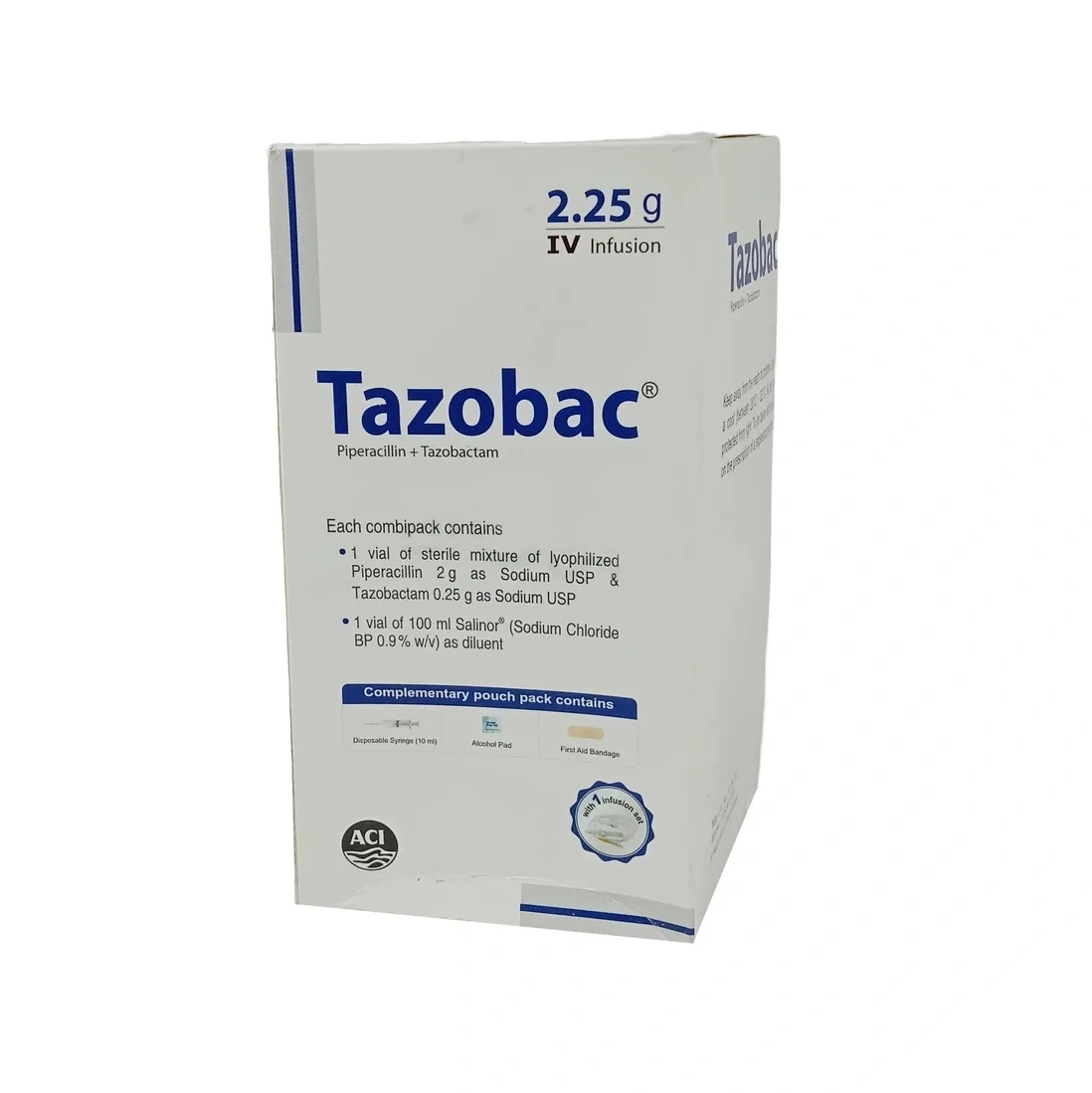

Medicine Overview of Tazobac 2.25 2gm+0.25gm Injection
Tazobac 2.25 is a combination of two antibiotics. It is used to treat various types of bacterial infections. It fights against the infection by killing the microorganisms.
Tazobac 2.25 is generally administered by a healthcare professional and should not be self-administered. Depending on the severity of your underlying illness, your doctor will decide the precise dose and schedule as per which this injection is to be given. It is strictly advised to be used as per the doctor’s prescription.
Some of the common side effects of this medicine include nausea, vomiting, diarrhea, and rash. Additionally, you may notice some injection site reactions like pain, swelling, or redness. You should consult your doctor if these side effects do not get better with time and persist for a longer duration.
Before using the medicine, you should tell your doctor if you are allergic to any antibiotics or have any kidney or liver problems. Your doctor may change the dose or prescribe a different medicine. This medicine is generally considered safe to use during pregnancy and breastfeeding if used under a doctor’s supervision.
Show less
- Bacterial infections
- Nausea
- Vomiting
- Diarrhea
- Rash
- Allergic reaction
-
You have been prescribed this combination medicine to treat bacterial infections even if they have developed resistance.
-
Finish the prescribed course, even if you start to feel better. Stopping it early may make the infection come back and harder to treat.
-
Diarrhea may occur as a side effect. Taking probiotics along with Tazobac 2.25 may help. Talk to your doctor if you notice bloody stools or develop abdominal cramps.
-
Stop taking Tazobac 2.25 and inform your doctor immediately if you develop an itchy rash, swelling of the face, throat or tongue or breathing difficulties while taking it.
Reconstitution
Reconstitute initially (2.25 g in 10 mL, 4.5 g in 20 mL) w/ water for inj, glucose 5% or NaCl 0.9%, then further dilute to 50-150 mL w/ compatible infusion soln.
IV Administration
Infusion over 30 min
Show less
Intravenous
Nosocomial pneumonia
Adult: Each vial contains 4.5 g (piperacillin 4 g and tazobactam 0.5 g): 4.5 g 6 hrly for 5-14 days by infusion over 30 min. When used empirically, combination w/ aminoglycoside or antipseudomonal fluoroquinolone is recommended.
Empiric therapy for febrile neutropenic patients
Adult: Each vial contains 4.5 g (piperacillin 4 g and tazobactam 0.5 g): 4.5 g 6 hrly for 5-14 days by infusion over 30 min.
Complicated intra-abdominal infections
Adult: Each vial contains 4.5 g (piperacillin 4 g and tazobactam 0.5 g): 4.5 g 8 hrly for 5-14 days by infusion over 30 min.
Complicated urinary tract infections; Skin and soft tissue infections
Adult: Each vial contains 4.5 g (piperacillin 4 g and tazobactam 0.5 g): 4.5 g 8 hrly for 5-14 days by infusion over 30 min.
Show less
Intravenous
Child: Usually <40 kg: 240–300 mg PIP/kg/day 8 hourly
Alternatively
Nosocomial pneumonia
Child: 2-12 yr 90 mg/kg (piperacillin 80 mg/kg and tazobactam 10 mg/kg) 6 hrly for 5-14 days by infusion over 30 min.
Max: 4.5 g per dose; >12 yr Same as adult dose.
Empiric therapy for febrile neutropenic patients
Child: 2-12 yr 90 mg/kg (piperacillin 80 mg/kg and tazobactam 10 mg/kg) 6 hrly for 5-14 days by infusion over 30 min.
Max: 4.5 g per dose; >12 yr Same as adult dose.
Complicated intra-abdominal infections
Child: 2-12 yr 112.5 mg/kg (piperacillin 100 mg and tazobactam 12.5 mg) 8 hrly for 5-14 days by infusion over 30 min.
Max: 4.5 g per dose.
Show less
Renal impairment: Haemodialysis patients: 2.25 g 12 hrly; additional dose of 0.75 g after each dialysis session. CAPD: 2.25 g 12 hrly.
CrCl (ml/min) Dosage Recommendation
<20 2.25 g 8 hrly.
20-40 2.25 g 6 hrly.
Show less
Pregnancy and lactation, pseudomembranous colitis. Assess hematopoietic function periodically. Perform periodic electrolyte determinations in patients with low K reserves. Increased risk of fever and rash in patients with cystic fibrosis. Increased risk of bleeding manifestations. Prolonged treatment may increase risk of superinfections. Convulsions or neuromuscular excitability may occur when high doses are used, especially in renally impaired patients. Renal impairment.
Lactation: Low concentrations of piperacillin excreted in breast milk; tazobactam unknown; use caution
Show less
>10%
Diarrhea (7-11%)
1-10%
Constipation (1-8%),Headache (1-8%),Insomnia (4-7%),Nausea (2-7%),Fever (2-5%),Oral candidiasis (2-4%),Rash (2-4%),Vomiting (2-4%),Dyspepsia (3%),Pruritus (3%),Pain (2-3%),Hypertension (2%),Leukopenia (1%),Thrombocytopenia (1.4%)
<1%
Anaphylaxis,Agranulocytosis,Thrombocytopenia,Eosinophilia,Leukopenia,Positive Coombs test,Prolonged PT and PTT,Transient LFT and creatinine elevations.Seizure,Pulmonary edema,Pulmonary embolism
Show less


Reviews
Clear filtersThere are no reviews yet.