


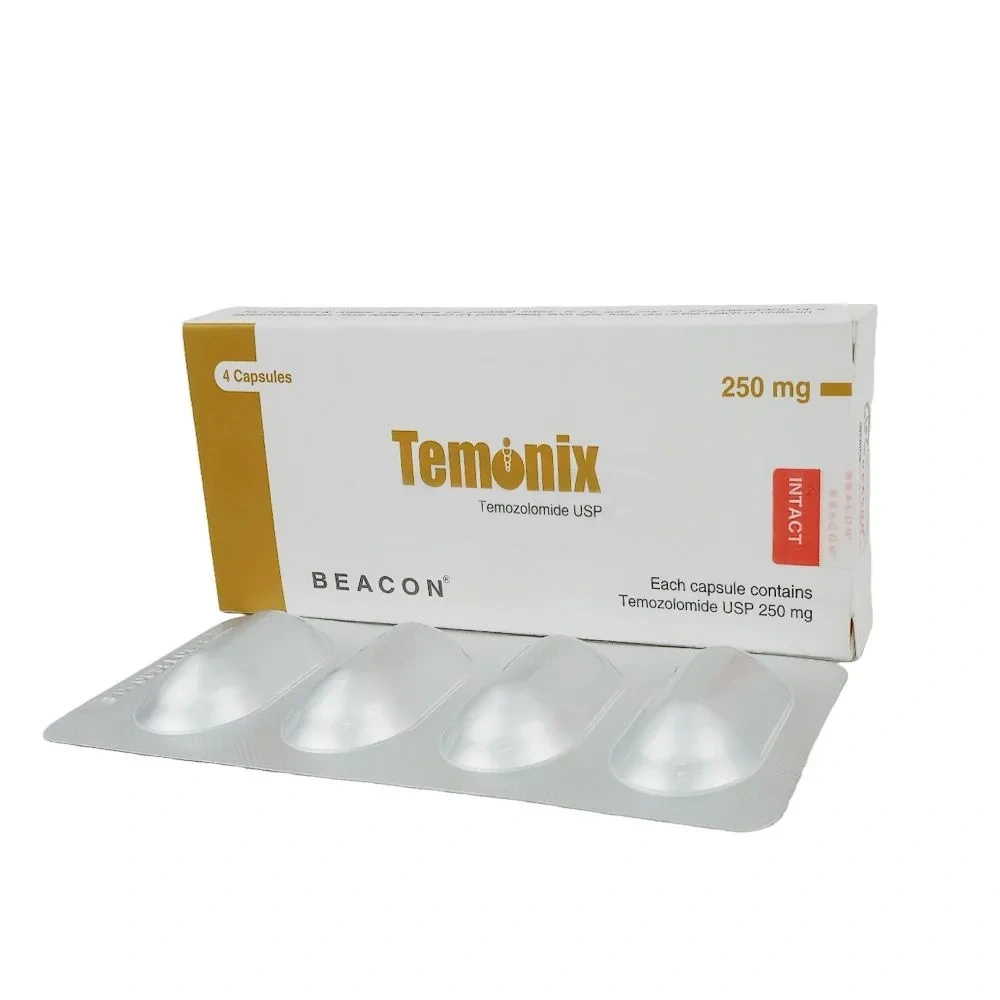

Medicine Overview of Temonix 250mg Capsule
Temonix 250 is used in the treatment of a specific type of cancer of the brain. It is used to treat brain tumors if they return or get worse after standard treatment. It may be also used to treat other conditions, as determined by the doctor.
Temonix 250 should be taken empty stomach and at same time each day to make sure it has the best effect. Your doctor will decide what dose is necessary and how often you need to take it. This will depend on what you are being treated for and may change from time to time. You should take it exactly as your doctor has advised. Taking it in the wrong way or taking too much can cause very serious side effects. It may take several weeks or months for you to see or feel the benefits but do not stop taking it unless your doctor tells you to.
The most common side effects of this medicine include nausea, vomiting, constipation, headache and fatigue. This medicine may reduce the number of blood cells in your blood thereby, increasing the susceptibility to infections. Regular blood tests are required to check your blood cells along with kidney, liver and heart function during treatment with this medicine.
Before taking it, tell your doctor if have bleeding, liver, or kidney problems or are taking any medicines to treat infections. Many other medicines can affect, or be affected by, this medicine so let your doctor know all medications you are using. This medicine is not recommended during pregnancy or while breastfeeding. It may harm your baby. You and your partner should avoid becoming pregnant or fathering a child for several months after your treatment with it has stopped.
- Brain tumor
- Nausea
- Vomiting
- Constipation
- Headache
- Fatigue
- Convulsion
- Coordination disorder
- Diarrhea
- Dizziness
- Fever
- Hair loss
- Hemiparesis (weakness on one side of the body)
- Insomnia (difficulty in sleeping)
- Loss of appetite
- Memory loss
- Rash
- Viral infection
- Weakness
-
Swallow full tablets on an empty stomach, one hour before your meal.
-
Avoid being near people who are sick or have infections. Consult your doctor if you develop symptoms of opportunistic infections (such as Pneumocystis jirovecii pneumonia) and reactivation of infections (such as hepatitis B virus) Using temozolomide may increase your risk of developing certain types of bone marrow cancer. Be aware about your specific risk.
-
You may be given medication to prevent nausea or other side effects while you are receiving temozolomide.
-
Your blood will be tested frequently during treatment to monitor the side effects of temozolomide on your blood cells as you may have a small risk of other changes in blood cells, including leukemia.
-
Avoid activities that may increase your risk of bleeding or injury. Use extra care to prevent bleeding while shaving or brushing your teeth.
-
Do not drink alcohol while taking temozolomide.
-
Do not drive or operate machinery while using temozolomide as it may make you tired or sleepy.
-
Both male and female patients should take effective contraceptive precautions during and after 6 months of treatment. Male patients should seek advice on conservation of sperm prior to treatment as temozolomide treatment may cause infertility.
Should be taken on an empty stomach. Take on an empty stomach at least 1 hr before meals.
Swallow capsules whole with a full glass of water on an empty stomach or at bedtime. Do not take a 2nd dose if capsules are vomited.
Oral
Glioblastoma multiforme
Adult: 75 mg/m2 once daily for 42 days with focal radiotherapy (concomitant phase). Do not reduce dose during concomitant phrase but interrupt or discontinue therapy depending on toxicity.
Continue if absolute neutrophil count (ANC)> 1.5×10⁹/L, thrombocyte count >100×109/L and Common Toxicity Criteria (CTC) non-haematological toxicity < Grade 1 (except for alopecia, nausea and vomiting).
Initiate monotherapy 4 wk after completing concomitant phase: 150 mg/m2 once daily for 5 days followed by a 23 day break (1 cycle).
In cycle 2, increase dose to 200 mg/m2 once daily for 5 days, if ANC >1.5×10⁹/L, thrombocyte count >100×109/L and CTC non-haematological toxicity for cycle 1 is < Grade 2 (except for alopecia, nausea and vomiting).
If dose cannot be increased in cycle 2, do not increase dose in subsequent cycles. Dose used in cycle 2 is given for the rest of the cycles, toxicity allowing, up to 6 cycles.
Anaplastic Astrocytoma
Indicated for the treatment of adults with refractory anaplastic astrocytoma (ie, patients with disease progression on a drug regimen containing nitrosourea and procarbazine)
Initial: 150 mg/m² PO/IV qDay for 5 days; repeat at 28-day cycles
Maintenance: May increase/maintain dose at 200 mg/m² PO/IV qDay for 5 days/28-day cycle if ANC >1500 mm³ and platelets >100,000 mm³
Infuse IV over 90 minutes
Dosage modifications
Measure ANC and platelet on days 22 & 29 (day 1 of next cycle); modify dose for following cycle if:
ANC 1000-1500/mm³ or platelet 50,000-100,000/mm³: Postpone treatment until ANC >1500/mm³ and platelet >100,000/mm³; maintain initial dose
ANC <1,000/mm³ or platelets <50,000/mm³:
-Postpone therapy until ANC >1,500/mm³ and platelets >100,000/mm³
-Decrease dose by 50 mg/m²/day for subsequent cycles
-Do NOT administer drug at dose <100 mg/m² for anaplastic astrocytoma
Decrease maintenance dose
Reduce from 200 mg/m²/day to 150 mg/m²/day and from 150 mg/m²/day to100 mg/m²/day if:
-ANC< 10,000/mm³
-Platelets <50,000/mm²
-CTC Grade 3 non-hematologic toxicity
Recurrent or progressive malignant gliomas
Adult: Previously untreated with chemotherapy: 200 mg/m2 once daily for 5 days, followed by a 23 day break (1 cycle).
Previously treated with chemotherapy: 150 mg/m2 daily for 5 days followed by 23 day break (1 cycle) increased to 200 mg/m2 daily for the 2nd cycle if there is no haematological toxicity.
Metastatic melanoma
Adult: 200 mg/m2 daily for 5 days every 28 days.
Oral
Recurrent or progressive malignant gliomas
Child: >3 yr: Previously untreated with chemotherapy: 200 mg/m2 once daily for 5 days, followed by a 23 day break (1 cycle).
Previously treated with chemotherapy: 150 mg/m2 daily for 5 days followed by 23 day break (1 cycle) increased to 200 mg/m2 for the 2nd cycle if there is no haematological toxicity.
Severe hepatic and renal impairment. Elderly >70 yr, children. Women of child bearing potential should avoid becoming pregnant during therapy. Males should be advised not to father a child up to 6 mth after treatment and to consider cryoconservation of sperms due to possibility of irreversible infertility. May impair ability to drive or operate machinery. Monitor CBC wkly during concomitant therapy and on day 22 of each 28 day treatment cycle, followed by wkly blood count until recovery. Hepatitis screening and prophylactic therapy with antiviral agents as clinically indicated to be considered.
Prophylaxis for Pneumocystis jiroveci (or Pneumocystis carinii) pneumonia (PCP) needed for all patients receiving concomitant temozolomide and radiation therapy for the 42-day regimen; if patients experience lymphocytopenia during the concomitant phase of therapy, PCP prophylaxis should be continued until recovery from lymphocytopenia. Monitor closely for PCP development in all patients. Anti-emetic prophylaxis recommended.
Lactation: Unknown if distributed into breastmilk, discontinue nursing due to potential risk.
>10%
Alopecia (55-69%),Lymphopenia (55%),Nausea (53%),Vomiting (42%),Headache (41%),Fatigue (34%),Constipation (33%),Anorexia (9-27%),Convulsions (23%),Thrombocytopenia (19%),Rash (8-19%),Hemiparesis (18%),Diarrhea (16%),Neutropenia (14%),Fever (13%),Asthenia (13%),Dizziness (12%),Peripheral edema (11%),Viral infections (11%)
1-10% (selected)
Amnesia (10%),Insomnia (10%),Abdominal pain (5-9%),Ataxia (8%),Back pain (8%),Paresis (8%),URI (8%),Urinary incontinence (8%),UTI (8%),Abnormal vision (5-8%),Pruritus (5-8%),Breast pain (6%),Depression (6%),Confusion (5%),Myalgia (5%),Weight gain (5%),Anemia (4%),Erythema (1%)



Reviews
Clear filtersThere are no reviews yet.