


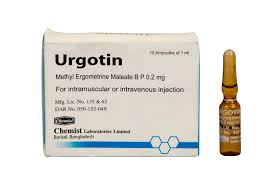

Introduction
Urgotin is a medicine used to control bleeding from the uterus, that may occur after childbirth or an abortion. It works on the smooth muscle of the uterus and increases tone, rate, and amplitude of contractions thus reduces blood loss. Urgotin can be taken with or without food, but take it at the same time to get the most benefit. It should be taken as your doctor’s advice. The dose and how often you take it depends on what you are taking it for. Your doctor will decide how much you need to improve your symptoms. Swallow the tablets whole with a drink of water. You should take this medicine for as long as it is prescribed for you. The most common side effects of this medicine include headache, increase in blood pressure and seizure. If these bother you or appear serious, let your doctor know. There may be ways of reducing or preventing them. Generally, alcohol should be avoided while taking this medicine. Before taking this medicine, let your doctor know if you have ever had heart disease or you have high blood pressure. Your doctor should also know about all other medicines you are taking as many of these may make this medicine less effective or change the way it works.
Show less
Uses of Urgotin
Post-delivery bleeding
Side effects of Urgotin
Common
High blood pressure
Headache
Seizure
How to use Urgotin
Take this medicine in the dose and duration as advised by your doctor. Swallow it as a whole. Do not chew, crush or break it. Urgotin may be taken with or without food, but it is better to take it at a fixed time.
How Urgotin works
Urgotin is an ergot alkaloid. It works by causing sustained contractions of the smooth muscles of the uterus. This results in compression of the blood vessels which controls bleeding after delivery.
What if you forget to take Urgotin?
If you miss a dose of Urgotin, take it as soon as possible. However, if it is almost time for your next dose, skip the missed dose and go back to your regular schedule. Do not double the dose.
Quick Tips
Urgotin is used for the prevention and control of post-delivery bleeding.
It may also be used for the active management of the third stage of labor, to facilitate the delivery of the placenta.
It should be avoided in patients, with high blood pressure, and heart disease.
Brief Description
Indication
Migraine, Miscarriage, Uterine hemorrhage, Spontaneous or elective abortion, Uterine atony, Second stage of labor
Adult Dose
Oral: Prophylaxis of postpartum haemorrhage Adult: 200 mcg 3-4 times daily in the puerperium for 2-7 days. Intramuscular Treatment and prophylaxis of postpartum and postabortal haemorrhage Adult: 200 mcg. May repeat every 2-4 hr. Max: 5 doses. Intravenous Treatment and prophylaxis of postpartum and postabortal haemorrhage Adult: As an emergency measure: 200 mcg by slow inj over at least 1 minute, may repeat every 2-4 hr, up to a max of 5 doses.
Show less
Contraindication
Hypertension, eclamptic or previously hypertensive patients, heart disease, venoatrial shunts, mitral valve stenosis, obliterative vascular disease. Do not use in cases of threatened spontaneous abortion. Pregnancy.
Mode of Action
Ergometrine causes contraction of the uterine muscle. At low doses, there is an increase in frequency and amplitude of contractions while at higher doses, the basal tone of the uterus is increased. Ergometrine also causes vasoconstriction of peripheral and cerebral vessels.
Precaution
Captivation of the placenta may occur if given during the 2nd or 3rd stage of labour prior to delivery of the placenta; use in this situation should only be done by a qualified personnel. Avoid prolonged use. Caution in patients with sepsis, hepatic or renal impairment. Lactation.
Side Effect
Headache, dizziness, hallucinations; tinnitus; nausea, vomiting, foul taste, diarrhoea; hypertension, temporary chest pain, palpitations, bradycardia; nasal congestion, dyspnoea; diaphoresis; thrombophlebitis; haematuria; water intoxication; leg cramps; allergic reactions. Potentially Fatal: Shock.
Show less





Reviews
Clear filtersThere are no reviews yet.