



Introduction
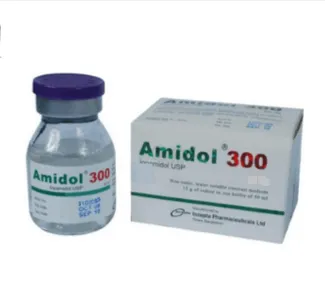
Amidol 300 is known as a contrast agent. It is injected into the body before an X-ray test or CT scan to enhance the visibility of internal body structures like blood vessels and non-bony structures. Some side effects of this agent include injection site reactions (pain, swelling and redness), nausea and hot flashes. This medicine is given under the supervision of a healthcare professional.
Uses of Amidol 300
Diagnostic agent
Side effects of Amidol 300
Common
Injection site reactions (pain, swelling, redness)
Nausea
Hot flashes
How to use Amidol 300
Your doctor or nurse will give you this medicine. Kindly do not self administer.
How Amidol 300 works
Amidol 300 is a radiopaque contrast agent. It contains iodine, a substance that absorbs x-rays and makes blood vessels and other non-bony tissues appear more clearly during an X-ray or CT scan.
What if you forget to take Amidol 300?
Not applicable. Amidol 300 is given before imaging test, so it is important to take it at the time as advised by the doctor. If you miss the dose, your test results can be inaccurate.
Brief Description
Indication
Radiographic contrast medium for diagnostic procedures
Adult Dose
Angiography Cerebral Arteriography 300 mg/mL: 8-12 mL intra-arterial, may repeat, not to exceed 90 mL Coronary Arteriography 370 mg/mL: 2-10 mL IV; monitor EKG; not to exceed 200 mL Coronary Ventriculography 370 mg/mL: 25-50 mL IV; monitor EKG; not to exceed 200 mL Selective Visceral Arteriography 370 mg/mL: Up to 50 mL IV; not to exceed 225 mL Selective Visceral Aortography 370 mg/mL: Up to 50 mL IV; not to exceed 225 mL Computed Tomography CECT of the Head, Body 300 mg/mL: 100-200 mL IV; not to exceed 200 mL Urography Excretory Urography 300 mg/mL: 50 mL IV OR 370 mg/mL: 40 mL IV
_
Child Dose
Angiocardiography For 370 mg/mL: <2 years: 10-15 mL IV, not to exceed 40 mL total 2-9 years: 15-30 mL IV, not to exceed 50 mL (2-4 years) or 100 mL (5-9 years) 10-18 years: 20-50 mL IV, not to exceed 125 mL Computed Tomography CECT of the Head, Body 300 mg/mL: 1-3 mL/kg IV; not to exceed 30 g of iodine Urography Excretory Urography 300 mg/mL: 1-3 mL/kg IV; not to exceed 30 g of iodine
_
Contraindication
Not for intrathecal use.
Mode of Action
Iopamidol is a nonionic iodinated radiographic contrast medium. It allows visualisation of internal body structures by opacifying the path of its flow.
Precaution
May inhibit blood coagulation. Multiple myeloma or other paraproteinaemia. Sickle-cell disease. Known or suspected phaeochromocytoma (monitor closely). Hyperthyroidism. Ensure adequate hydration. History of a previous sensitivity to a contrast medium, sensitivity to iodine, bronchial asthma, hay fever and food allergy. Monitor patients with CHF. Avoid angiography in patients with homocystinuria. Severe arterial or venous disease. Severe renal impairment, combined renal and hepatic disease or anuria, especially when large doses are used. Pregnancy and lactation. Lactation: Excretion into breast milk unknown; not recommended
_
Side Effect
Arrhythmias, arterial spasm, flushing, vasodilatation, angina, cardiopulmonary arrest; dizziness, confusion, paraesthesia, visual disturbances, seizure, paralysis, coma, temporary amnesia; inj site pain, pallor, periorbital and facial oedema; coughing, sneezing, rhinitis, asthma, apnoea, laryngeal oedema, chest tightness; watery itchy eyes, lachrymation, conjunctivitis; muscle spasm, involuntary leg movement; tremors, malaise; severe retching and choking, abdominal pain; urogenital pain, haematuria. Potentially Fatal: Severe anaphylactoid reactions.
_
Interaction
Arrhythmias, arterial spasm, flushing, vasodilatation, angina, cardiopulmonary arrest; dizziness, confusion, paraesthesia, visual disturbances, seizure, paralysis, coma, temporary amnesia; inj site pain, pallor, periorbital and facial oedema; coughing, sneezing, rhinitis, asthma, apnoea, laryngeal oedema, chest tightness; watery itchy eyes, lachrymation, conjunctivitis; muscle spasm, involuntary leg movement; tremors, malaise; severe retching and choking, abdominal pain; urogenital pain, haematuria. Potentially Fatal: Severe anaphylactoid reactions.
_



Reviews
Clear filtersThere are no reviews yet.