



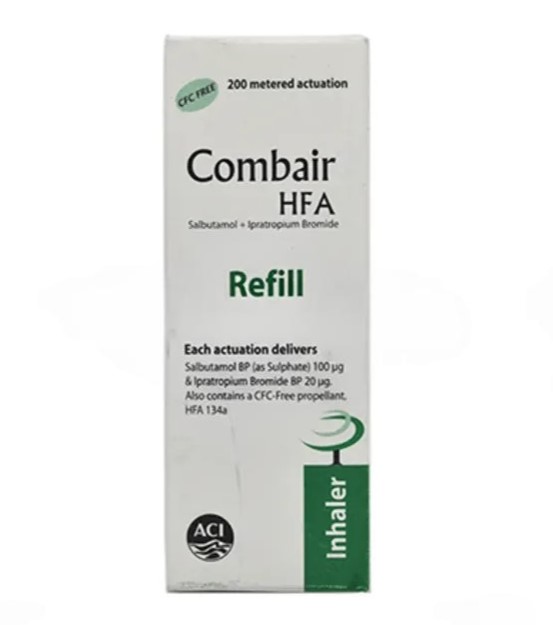

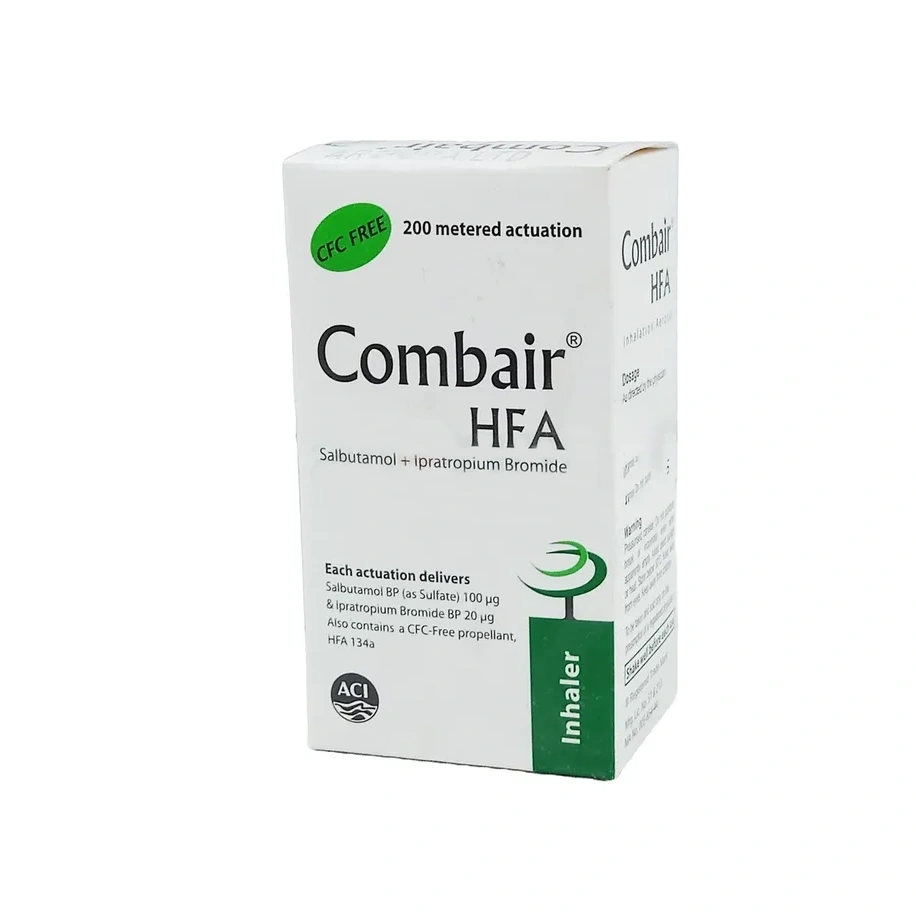
Medicine Overview of Combair HFA Refill 20mcg+100mcg/puff Inhaler
Combair HFA Refill is used for the treatment of chronic obstructive pulmonary disorder (a lung disorder in which the flow of air to the lungs is blocked). It helps in relaxing the muscles of the air passages and making it easier to breathe. It relieves coughing, wheezing and feeling short of breath.
Your doctor will tell you how often you need to use your inhaler. The effect of this medicine may be noticeable after a few days but will only reach its maximum after a few weeks. This medicine must be used regularly to be effective, so go on taking it even if you don’t have any symptoms. That means it’s doing its job. If you stop taking it your COPD may get worse. This medicine should not be used to relieve sudden shortness of breath. If sudden shortness of breath occurs, use your rescue inhaler. To get the benefit from this medicine you need to make sure you get your inhaler technique right, otherwise, it does not work as well.
The most common side effects are dryness in mouth, shortness of breath, cough, tremor, headache, palpitations, and muscle cramp. If you get there, don’t stop taking it but do talk to your doctor. You can prevent some of these symptoms by rinsing your mouth and throat with water or brushing your teeth after using your inhaler. There are other, rarer side effects which can be serious. Talk to your doctor if you’re worried about them.
Before taking it, you should tell your doctor if you have any kidney or liver diseases so that your doctor can prescribe a suitable dose for you. Also tell your doctor if you are pregnant, planning pregnancy or breastfeeding.
Show less
- Chronic obstructive pulmonary disease (COPD)
- Dryness in mouth
- Breathlessness
- Cough
- Tremor
- Headache
- Palpitations
- Muscle cramp
-
Combair HFA Refill is a combination of two medicines that makes breathing easier for patients with chronic obstructive pulmonary disease (COPD).
-
This medicine is for inhalation only. The tablet should not be swallowed.
-
It should be taken at the same time each day.
-
It does not work right away and should not be used to relieve sudden breathing problems. Use your rescue inhaler to control sudden difficulty in breathing.
-
Dry mouth may occur as a side effect. Frequent mouth rinses, good oral hygiene, increased water intake and sugarless candy may help.
-
Gargle with warm water after each inhalation to avoid any fungal infections in your mouth and throat.
-
Take the first dose of this medicine under medical supervision as it may cause wheezing or tightening of the airways (bronchospasm) immediately after using.
-
Your doctor may regularly monitor your blood potassium level as low oxygen level in the blood (hypoxia) and medicines such as Combair HFA Refill can lower blood potassium level.
-
Only miniscule amounts of Combair HFA Refill may get absorbed into the bloodstream after inhalation. Hence, serious side effects are unlikely.
Inhalation
Chronic obstructive pulmonary disease
Adult: Inhalation: 100 mcg/20 mcg (1 actuation of metered-dose inhaler) q6hr; not to exceed 6 actuations/day
Nebulizer solution: Initially, 3 ml every 6 hr. Max: 3 ml every 4 hr.
One ampoule as required for the relief of symptoms or as directed. Up to three to four ampoules daily.
Show less
The combination of Salbutamol & Ipratropium Bromide is contraindicated in patients with hypertrophic obstructive cardiomyopathy and tachyarrhythmia and in patients with a history of hypersensitivity to atropine or its derivatives, or to any other component of the product.
Show less
May cause paradoxical bronchospasm. Caution when used in patients who are sensitive to sympathomimetic agents. Caution when used in patients with CV disease as beta-agonists may increase BP, heart rate and risk of arrhythmias. Monitor blood glucose in diabetics. Monitor serum potassium levels especially in patients who are on concurrent treatment with xanthine derivatives, steroids or diuretics. Caution when used in patients with narrow angle glaucoma, hyperthyroidism, prostatic hyperplasia, bladder neck obstruction, seizure disorders, renal or hepatic impairment. Safety and efficacy have not been established in children <12 yr. Increased risk of GI motility disturbance in patients with cystic fibrosis. Pregnancy and lactation.
Lactation: Unknown whether drug is excreted in breast milk
Show less
>10%
Bronchitis (2-12%)
1-10%
Upper respiratory tract infection (1-10%),Lung disease (6%),Headache (3-6%),Dyspnea (2-5%),Nasopharyngitis (4%),Cough (3-4%),Pharyngitis (2-4%),Pain (1-3%),Chest pain (2.6%),Sinusitis (2.3%),Nausea (1-2%),Diarrhea (1.8%),Urinary tract infection (1.6%),Influenza (1.4%),Leg cramps (1.4%),Nausea (1.4%),Pneumonia (1.4%),Rhinitis (1.1%)
<1%
Allergic-type reactions, such as skin reactions (eg, rash, pruritus, urticaria [including giant urticaria]), angioedema (eg, of tongue, lips, face), laryngospasm, and anaphylaxis
Angina,Arrhythmia,Arthralgia,Dizziness,Dry mouth,Dyspepsia,Dysphonia,Edema,Fatigue,Hypertension,Insomnia,Nervousness,Palpitation,Paresthesia,Tachycardia,Tremor,Vomiting
Potentially Fatal: Anaphylactic reactions such as angioedema of tongue, lips or face and laryngospasm.
Show less







Reviews
Clear filtersThere are no reviews yet.