



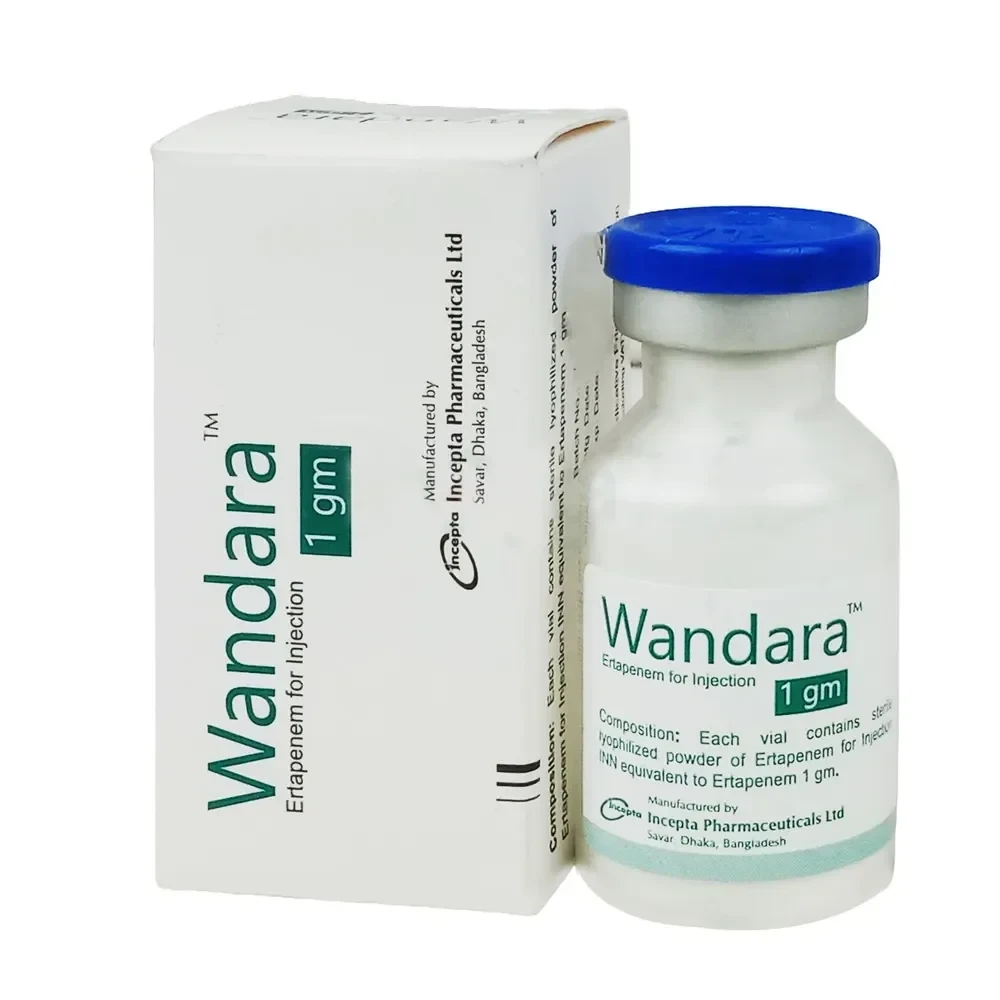

Introduction
Wandara is an antibiotic belonging to the carbapenem group that fights bacteria. It is used to treat severe infections of the skin, lungs, stomach, urinary tract, blood and brain (eg. meningitis). It works by killing the bacteria that cause these problems. Wandara is commonly used to treat seriously ill patients admitted to the hospital. This medicine is given by drip or by direct injection into a vein, under the supervision of a healthcare professional. The dose depends on what type of infection you have, where it is in the body and how serious it is. You should have your injections at the same time each day to get the most benefit and you should keep on taking this medicine for as long as you are prescribed it, even if your symptoms quickly improve. If you stop taking it too early the infection may return or worsen. Some people may develop side effects like headache, vomiting, nausea, diarrhea, rash or local redness and swelling at the site of injection. These side effects are usually temporary and go away during treatment as your body adjusts to the medicine. Consult your doctor if these side effects bother you or will not go away. Before starting treatment with this medicine, you should tell your doctor if you have epilepsy, liver or kidney problems or if you are allergic to any antibiotic. While using it, you may be advised blood tests to monitor your blood cell counts and kidney function. This medicine is generally regarded as safe to use in pregnancy and breastfeeding if prescribed by your doctor.
_
Uses of Wandara
Bacterial infections
Side effects of Wandara
Common
Injection site reactions (pain, swelling, redness)
Vomiting
Nausea
How to use Wandara
Your doctor or nurse will give you this medicine. Kindly do not self administer.
How Wandara works
Wandara is an antibiotic. It kills bacteria by preventing them from forming the bacterial protective covering (cell wall) which is needed for them to survive.
What if you forget to take Wandara?
If you miss a dose of Wandara, please consult your doctor.
Quick Tips
Wandara is an antibiotic that’s usually only given in the hospital for serious infections.
It is given by a drip into a vein (intravenous infusion) over 20 to 60 minutes.
Inform your doctor if you are allergic to penicillin or if you are taking any seizure medication before starting treatment with this medication.
Diarrhea may occur as a side effect. Inform your doctor if you develop severe stomach pain or if you find blood in your stools.
Your doctor may monitor your liver and kidney function while you are having treatment with this medication.
Brief Description
Indication
Intra-abdominal infections, Community-acquired pneumonia, Skin and skin structure infections, Urinary tract infections, Pyelonephritis, Surgical infections, Diabetic foot infections, Septic abortion
Administration
IV Preparation Reconstitute 1 g vial with 10 mL SWI, NS, or BWI; shake well; transfer to 50 mL NS IV Administration Infuse over 30 minutes IM Preparation Reconstitute 1 g vial with 3.2 mL of 1% lidocaine injection (without epinephrine); shake well; use within 1 hour after preparation IM Administration Make sure patient does not have allergy to lidocaine or another amide anesthetic Administer by deep IM injection into large muscle mass (eg, gluteal muscle or lateral part of thigh) Do not administer IM preparation or drug reconstituted for IM administration IV
_
Adult Dose
Community-Acquired Pneumonia 1 g/day IV/IM up to 14 days; after ?3 days of parenteral therapy, may be switched to appropriate PO regimen if patient improves clinically Complicated Urinary Tract Infections (Including Pyelonephritis) 1 g/day IV/IM up to 14 days; after ?3 days of parenteral therapy, may be switched to appropriate PO regimen if patient improves clinically Acute Pelvic Infections 1 g/day IV/IM for 3-10 days Complicated Intra-abdominal Infections 1 g/day IV/IM for 5-14 days Complicated Skin/Skin Structure Infections 1 g/day IV/IM for 7-14 days; may be continued up to 4 weeks for diabetic foot infections, depending on severity of infection and response to therapy (treatment excludes diabetic foot infections with osteomyelitis)
_
Child Dose
Community-Acquired Pneumonia, Complicated Urinary Tract Infections (Including Pyelonephritis) 3-12 years: 15 mg/kg IV/IM q12hr up to 14 days; not to exceed 1 g q12hr; after ?3 days of parenteral therapy, may be switched to appropriate PO regimen if patient improves clinically >12 years: 1 g/day IV/IM up to 14 days; after ?3 days of parenteral therapy, may be switched to appropriate PO regimen if patient improves clinically Complicated Intra-abdominal Infections, Complicated Skin/Skin Structure Infections 3-12 years: 15 mg IV/IM q12hr for 7-14 days >12 years: 1 g/day IV/IM for 7-14 days <3 years: Safety and efficacy not established
_
Renal Dose
Renal impairment CrCl >30 mL/min/1.73 m²: Dosage adjustment not necessary CrCl <30 mL/min/1.73 m² and end-stage renal disease (ESRD): 500 mg/day IV Dialysis: 500 mg/day IV; if given ?6 hr before dialysis, supplemental dose of 150 mg afterward
_
Contraindication
Hypersensitivity; lactation.
Mode of Action
Ertapenem acts similarly to penicillins by bacterial cell wall inhibition. It is active against many gram-negative and aerobic and anaerobic organisms. It is stable to hydrolysis by beta-lactamases.
Precaution
Hypersensitivity to penicillins, cephalosporins or other beta-lactams (possibility of cross-sensitivity). Renal impairment; CNS disorders e.g. epilepsy. Pregnancy. Lactation: Drug distributed in breast milk; use with caution
_
Side Effect
>10% Diarrhea (2-12%) 1-10% Elevated liver function tests (LFTs) (7-9%),Nausea (6-9%),Headache (6-7%),Infused vein complications (5-7%),Increased platelet count (4-7%),Increased alkaline phosphatase (4-7%),Altered mental status (3-5%),Fever (2-5%),Abdominal pain (4%),Vomiting (4%),Constipation (3-4%),Insomnia (3%),Swelling or edema (3%),Drug rash with eosinophilia and systemic symptoms (DRESS syndrome) (2-3%),Rash (2-3%),Vaginitis (1-3%),Dizziness (2%),Phlebitis or thrombophlebitis (1.5-2%),Pruritus (1-2%),Tachycardia (1-2%),Acid regurgitation (1-2%),Eosinophilia (1-2%),Hypotension (1-2%),Erythema (1-2%),Hypertension (0.7-2%),Chest pain (1%),Dyspepsia (1%),Fatigue (1%),Anxiety (0.8-1%),Oral candidiasis (0.1-1%) Potentially Fatal: Pseudomembranous colitis, Stevens-Johnson syndrome.
_
Pregnancy Category Note
Pregnancy Available data from a small number of postmarketing cases with use in pregnancy are insufficient to inform any drug-associated risks for major birth defects, miscarriage, or adverse maternal or fetal outcomes Animal data In animal reproduction studies after intravenous administration of ertapenem during period of organogenesis, there was no evidence of developmental malformations in rats at systemic exposures (AUC) up to approximately 1.2 times the human exposure at maximum recommended human dose (MRHD) and in mice at doses up to approximately 3 times MRHD based on body surface area comparison; in pregnant rats administered ertapenem during organogenesis through lactation, fetal toxicity, developmental delays, and impaired reproduction did not occur in first generation offspring at systemic exposures (AUC) approximately 1.2 times the human exposure at MRHD Lactation Ertapenem is present in human milk; there are no data on effects on breastfed infant or on milk production; developmental and health benefits of breastfeeding should be considered along with mother’s clinical need for therapy and any potential adverse effects on breastfed infant from drug or from underlying maternal condition
_
Interaction
May decrease plasma levels of valproic acid thus, increasing the risk of seizures. Increased plasma concentrations w/ probenecid.




Reviews
Clear filtersThere are no reviews yet.